
Automatic For the Poet
On Some Romantic Processes

The New York Quarterly was an influential poetry magazine right from its founding in 1969 by William Packard. Rolling Stone hailed it “the most important poetry magazine in America,” back when Rolling Stone’s opinion still meant something. In its heyday the Quarterly published interviews on the craft of poetry from some of the most influential poets working at the time: Auden, Sexton, Kunitz, Levertov, Bukowski, Ashbery, Creeley, Wilbur.
Like The Paris Review’s Art of Poetry series, these interviews focused on the practices and circumstances that give rise to a poet’s work. The interviewers had a good understanding of that work, but it was the craft itself that was of greatest interest. As such, the interviews are valuable for any fans who might happen to be interested in, say, which critics influenced Auden, or why Ashbery used a voice recorder, or that Wilbur finds Wordsworth “damnably earnest.”1
In 1970 Allen Ginsberg was interviewed, and although he was loath to speak of it in those terms (“Capital C-R-A-F-T,” he joked) he was nonetheless quite open about his process of poetic composition.
Ginsberg was a neoromantic poet, like most of the Beats, and like many of the postmodern schools of the midcentury.2 He believed, like Wordsworth, that poetry was essentially “the spontaneous overflow of powerful feeling.” Sometimes Ginsberg induced that feeling himself with drugs, as in “Wales Visitation” which he tells NYQ was written while under the influence of LSD; sometimes the occasion was more impromptu, as in “Sunflower Sutra,” written in twenty minutes while Kerouac was waiting for Ginsberg by the door.
I said, “Wait a minute, I got to write myself a note.” I had the Idea Vision and I wanted to write it down before I went off to the party, so I wouldn’t forget.
Ginsberg wrote most often in fits of inspiration, when the feeling came on. His ideal mode of poetic composition was the “prophetic illuminative seizure.” He wrote in states of epiphany, and paid attention to the activity of the mind in that moment of poetic creation. The greater the attention, according to Ginsberg, the more feeling emerged from it.
That’s the idea: to be in a state of such complete blissful consciousness that any language emanating from that state will strike a responsive chord of blissful consciousness from any other body into which the words enter and vibrate.
“Sunflower Sutra” is Ginsberg’s “Tintern Abbey.” They’re both poems of joyous epiphany, where the poet, struck by the beauty of the natural world, “sees into the life of things.” Wordsworth on the banks of the Wye, Ginsberg on “a tincan banana dock.” Wordsworth looks out at the “steep and lofty cliffs” from the shade of a sycamore, Ginsberg at the sunsent over the “box house hills” from the shade of a Pacific locomotive. Both are meditations, recollections of transcendence, spurred on by nature and by the sight of their companion. Dorothy stands beside Wordsworth, Kerouac sits next to Ginsberg. Through Dorothy, Wordsworth intuits “the language of my former heart,” and through the sunflower Kerouac hands him, Ginsberg imagines the perfect beauty of humanity that defeats both death and “human locomotives.”
that sooty hand or phallus or protuberance of artificial worse-than-dirt—industrial—modern—all that civilization spotting your crazy golden crown—3
If we’re to believe Ginsberg, it took him only twenty minutes to write “Sunflower Sutra.” There was little revision to his poetic process, so what we have is likely what he managed to write in those twenty minutes. As he tells NYQ
When attention is focused, there is no likelihood there will be much need for blue penciling revision because there’ll be a sensuous continuum. […] if you’re interested in writing as a form of meditation or introspective yoga, which I am, then there’s no revision possible.
Ginsberg had developed a mode of poetic production that was meditative, immediate, and spontaneous. His improvisation of images is impressive. The way he summons, one after another, a heap of broken images. A master of the catalogue and the long breath line; of asyndeton, too, that rushes the images by; and of an accumulation of adjectives, disordered but repetitive, rhythmic, that compels one to pay attention to the sound of words. These were the skills that he perfected throughout the course of his career.
In the interview, he describes the act of writing as “secretarial.” A poem, for Ginsberg, is something transcribed, taken down like dictation, from an endless, uninterrupted interior voice.
You observe your own mind during the time of composition and write down whatever goes through the ticker tape of mentality.
What passes through the mind is the poem. The subject is the activity of the mind in that moment of composition. The poet need only attend to it, need only keep up with it in order to get down what’s there. Traditional forms, then, with their imposed structures, are a hindrance to Ginsberg’s process. The form is instead the “time of composition,” the time it takes one to write things down. The craft, for Ginsberg, therefore, lay in the act of observing in that moment “the flashings of the mind.”
The craft is observing the mind. Formerly the ‘craft’ used to be an idea of rearranging your package, rearranging. Using the sonnet is like a crystal ball to pull out more and more things from the subconscious (to pack into the sonnet like you pack an ice cream box). Fresher method of getting at that material is to watch mind flow instantaneously, to realize that all that is, is there in the storehouse of the mind within the instant any moment.
Of course, in the case of “Sunflower Sutra,” Ginsberg was also consciously imitating “Tintern Abbey.” The incident with the sunflower awakened in him not only “memories of Blake,” as he says in the poem, but memories of “Tintern Abbey.” Wordsworth was a great influence, and Ginsberg had probably committed the poem, and its form, to memory. So he did in fact have a form in mind. His subject, too, was his time with Kerouac on the tincan banana dock, and the experience of holding the sunflower and seeing in it something which he thought Wordsworth must’ve also seen looking down into the Wye. What that something was, and what Ginsberg would say about it, however, would be a matter of the moment, a matter of that “blissful consciousness” in which Ginsberg aimed to compose, which, in the case of “Sunflower Sutra,” lasted twenty minutes before leaving for a party with Kerouac.
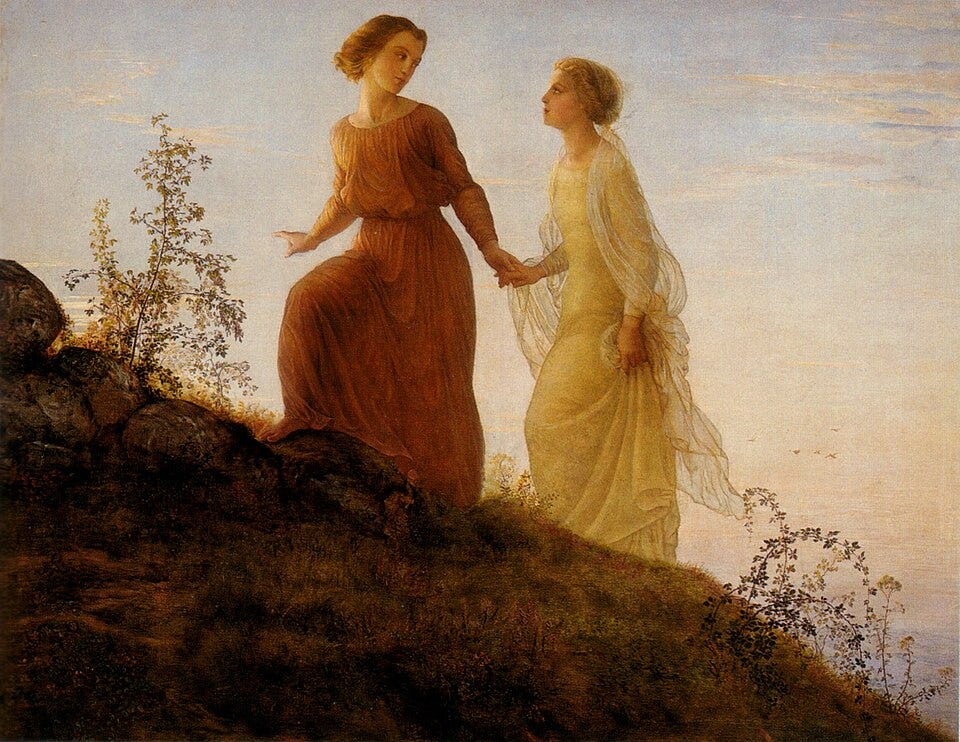
It took Ginsberg twenty minutes to write “Sunflower Sutra.” While we don’t know how long it took Wordsworth to write “Tintern Abbey,” we do know that five years had passed since he’d seen the waters rolling inland from their mountain-springs. “Five summers, with the length Of five long winters!” So in one sense at least, it took him five years to write. The poem at the very least suggests a depth of recollection that “Sunflower Sutra” lacks.
Compare the insight that culminates in Wordsworth’s poem
And I have felt
A presence that disturbs me with the joy
Of elevated thoughts; a sense sublime
Of something far more deeply interfused,
Whose dwelling is the light of setting suns,
And the round ocean, and the living air,
And the blue sky, and in the mind of man,
A motion and a spirit, that impels
All thinking things, all objects of all thought,
And rolls through all things.
to that of Ginsberg’s
You were never no locomotive, Sunflower, you were a sunflower!
And you Locomotive, you are a locomotive, forget me not!
We don’t know what time passed between Ginsberg’s experience on the dock and his writing it down, but it certainly feels like it could have been the same day. One assumes it would need to be fresh enough in the mind to be able to get down with some fidelity. The immediacy of the poem was also a function of Ginsberg’s process. The difference in depth between them, and what makes “Tintern Abbey” superior to “Sunflower Sutra,” in my opinion, has to do with the way in which the poets conceived of their processes.
For Wordsworth the “spontaneous overflow of powerful feeling” was always something the poet reflected on. It was not a part of the process itself, but simply the material for it.
I have said that Poetry is the spontaneous overflow of powerful feelings: it takes its origin from emotion recollected in tranquillity: the emotion is contemplated till by a species of reaction the tranquillity gradually disappears, and an emotion, similar to that which was before the subject of contemplation, is gradually produced, and does itself actually exist in the mind.4
Here the act of contemplation creates a similar but not identical emotion. What exists before the mind when writing is something which lends itself to inspection. But for Ginsberg the act of writing was itself the spontaneous emotion. For Wordsworth the feeling was the subject, for Ginsberg the subjectivity. This is the crucial difference between the English Romantics of the 19th century and the American Romantics of the 20th.
One finds the same thing in Charles Olson, the founder of the Black Mountain school. Olson, in his Projectivist manifesto outlined a similar program of immediacy.
Now the process of the thing, how the principles can be made so to shape the energies that the form is accomplished. And I think it can be boiled down to one statement […] ONE PERCEPTION MUST IMMEDIATELY AND DIRECTLY LEAD TO A FURTHER PERCEPTION
His famous dictum, “FORM IS NEVER MORE THAN AN EXTENSION OF CONTENT” is no different than Ginsberg calling the subject the activity of the mind in that moment, and form the “time of composition.”
Olson’s Projective Verse was published in 1950, four years before Ginsberg began working on Howl. On either American coast, the same romantic project was unfolding. Bloom would’ve called it a misreading of English Romanticism. What the Beats and the Black Mountain poets discovered5 was an automatic writing which, like the surrealists, sought to probe the depths of the irrational and the novel: a kind of writing which wants always to ride on the edge of consciousness, to cross the bar and sail beyond its horizons and see the other side. It’s also one that privileges the individual’s experience. If it was a misreading, it was a uniquely American one.
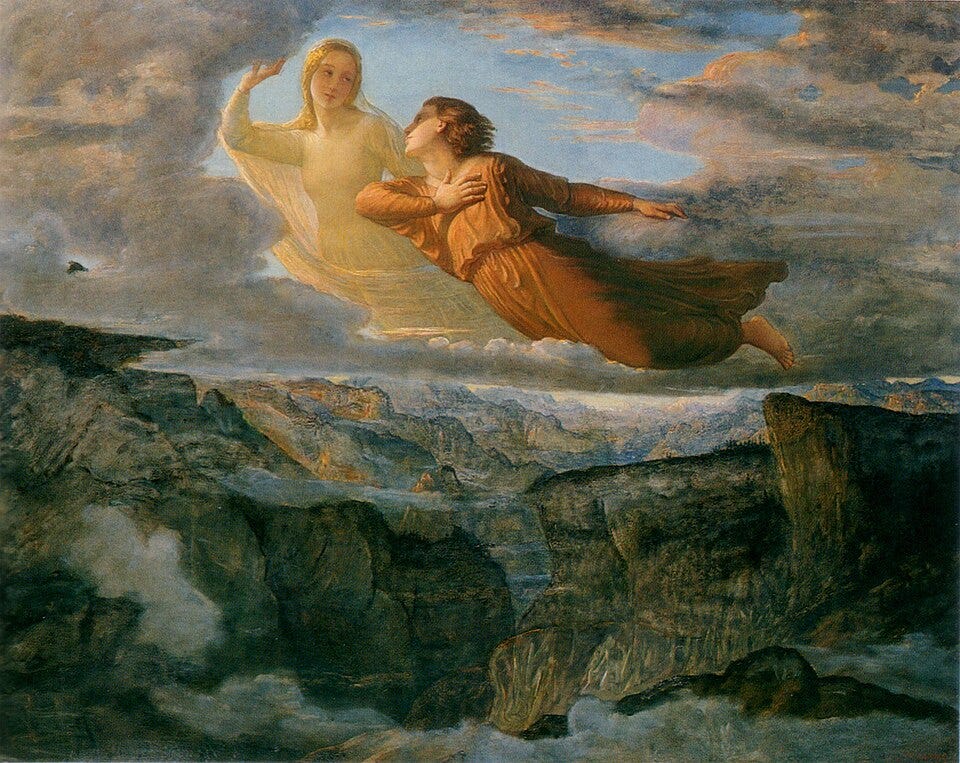
But the limits of such a process become obvious when one compares “Tintern Abbey” to “Sunflower Sutra.” One sacrifices in the pursuit of an eternal present a depth of introspection. Ginsberg’s transcendence is an immanence without content. Intense because immediately felt, yet conspicuously lacking in anything like the recollection it purports to possess. It does not, after all, reflect, it experiences.
Ginsberg is consciously imitating “Tintern Abbey,” he clearly wants us to draw comparisons with it, yet “Sunflower Sutra” does not reach anything like the depths of recollection of its predecessor. How could it? Ginsberg’s mode of production did not admit of such reflection. He banged out “Sunflower Sutra” twenty minutes before heading out to a party with Kerouac. His technique was to write in the moment of epiphany, when the feeling came on, and to write only in that time. And he did not admit revisions that might alter the fidelity of the poem from its original moment of ecstatic creation.6
Given the constraints, it’s impressive what Ginsberg managed to come up with. But it’s not impressive in the same way that “Tintern Abbey” is impressive. Its revelation not nearly as profound, nor its feelings as moving. Iain McGilchrist called “Tintern Abbey” one of the greatest poems ever written. I would put it high on my list, too.7 I return to the poem again and again because its gifts are unlimited, while the more I reread “Sunflower Sutra” the more its flaws reveal themselves to me. Its pleasures do not increase but empty themselves over time. It’s an ephemeral pleasure, the moment of ecstasy, not the pleasure of wisdom in recollection. It is the pleasure of gustation, of tasting words and images in quick succession. They dissolve on the tongue and leave nothing substantial. In that way it’s neither like “Tintern Abbey” nor the Indian Sutras which Ginsberg suggests by his title. “Sunflower Sutra” is neither reminiscence nor wisdom. It’s the pleasure of sounds, though not necessarily music. There’s nothing very musical in the poem. Even Ginsberg’s recital of it is strangely tuneless. He uses a droning voice, something between meditation and reading the newspaper.
That’s the idea: to be in a state of such complete blissful consciousness that any language emanating from that state will strike a responsive chord of blissful consciousness from any other body into which the words enter and vibrate.
Ultimately, Ginsberg falls short of his own standards of composition. His writing simply doesn’t, can’t, strike “a responsive chord of blissful consciousness,” because the language always lacks depth. It’s meant to be, after all, immediate and spontaneous language. It’s meant to float on the surface. It’s all bliss and no consciousness. And no amount of accumulation or repetition will make up for a lack of richness in language that does not make use of reason. This is the flaw in all automatic writing.
Wordsworth knew this, too. Though he rebelled against the Age of Reason and the idiom of the Augustans, against the “habits of expression” too polished and too remote from real language, “against the triviality and meanness both of thought and language,” yet he did not deny reason, he did not abandon it for mere spontaneous overflow.
For all good poetry is the spontaneous overflow of powerful feelings; but though this be true, Poems to which any value can be attached, were never produced on any variety of subjects but by a man who being possessed of more than usual organic sensibility had also thought long and deeply. For our continued influxes of feeling are modified and directed by our thoughts, which are indeed the representatives of all our past feelings …
The midcentury neoromantics were more antagonistic to reason. Their rebellion against the sober and learned spirit of the modernists was total. Such a process had happened before, a hundred and fifty years earlier, but not to the same degree.
I much prefer Wordsworth’s concept of blissful consciousness which he goes on to articulate.
… and as by contemplating the relation of these general representatives to each other, we discover what is really important to men, so by the repetition and continuance of this act feelings connected with important subjects will be nourished, till at length, if we be originally possessed of much organic sensibility, such habits of mind will be produced that by obeying blindly and mechanically the impulses of those habits we shall describe objects and utter sentiments of such a nature and in such connections with each other, that the understanding of the being to whom we address ourselves, if he be in a healthful state of association, must necessarily be in some degree enlightened, his taste exalted, and his affections ameliorated.
This is enlightenment and not only bliss. I find it nobler, more desirable, than anything in the neoromantics. History will bear it out, too, because one will be returned to more often, its lifespan longer, its fruits more nourishing.
The difference between the English Romantics and the American neoromantics is one of process. It’s a matter of the powerful feeling’s role in that process. In one it takes the shape of thinking “long and deeply.” in the other, characterized by Olson in Projective Verse, speed.
ONE PERCEPTION MUST IMMEDIATELY AND DIRECTLY LEAD TO A FURTHER PERCEPTION. It means exactly what it says, is a matter of, at all points (even, I should say, of our management of daily reality as of the daily work) get on with it, keep moving, keep in, speed, the nerves their speed, the perceptions, theirs, the acts, the split second acts, the whole business, keep it moving as fast as you can, citizen. And if you also set up as a poet, USE USE USE the process at all points, in any given poem always, always one perception must must must MOVE, INSTANTER, ON ANOTHER!
So there we are, fast, there’s the dogma.
If you’ve got this far, which mode do you prefer? What does your own poetic process look like?
Doubleday published the interviews as a book, The Craft of Poetry, edited by William Packard, from which the excerpts in this post are taken. After Packard’s death in 2002, Raymond Hammond took over NYQ, and the quality and relevance of the magazine seems to have fallen off. It still exists today, as a publisher of poetry books, but its website seems stuck in the early aughts, a relic that hasn’t kept up with technological changes in media.
Each in their own way, the Beats, the Black Mountain school, the New York school, the Confessional Poets, were all romantics.
“Tintern Abbey” has also been read as a critique of the transformations of the industrial revolution. Wordsworth leaves the “din of towns and cities” to return to the natural world, but the Wye Valley would’ve been undergoing industrialization. The Abbey itself, a ruined medieval monastery, has been read as emblematic of the changes Wordsworth would’ve been witness to. This is all implicit, historical, but not unreasonable.
From the Preface.
And to an extent the New York poets, too. Ashbery talks in his interview with the NYQ, about his process of composition for The Tennis Court Oath (1962)
I wasn’t satisfied with the way my work was going and I felt it was time to just clear my head by writing whatever came into it and that’s very much the case with that poem.
He also said that, although he never met Olson or read the Projective manifesto, he was essentially doing what they were doing.
Compare this with Richard Wilbur, who in his interview with NYQ says that his process involves a level of distance from the experience.
You become, then, two people, the advocate of your poem as you wrote it and the critic of it.
He gives a great reading, too.
I've been thinking of the state of inspiration as one of suggestibility. One receives suggestions from what – memories, subconsciously perceived patterns, the ether, some spirit, one's own hubris – and follows one suggestion after another. But to stop there and say, "This is finished," strikes me as the height of gullibility. A poet must be open to suggestions, but exercise judgment in which ones to accept. As with any art, the piece under production should be examined from a step away, and that which does it injury replaced with something else – another suggestion perhaps – that accords rationally and aesthetically with its essence. Or, should the whole be found to be a set of injuries, let the poet be decent enough to scrap it entirely. Let us be suggestible, but of sound judgment.
This is a great essay! The dichotomy you discuss between Ginsburg and Wordsworth really points out how modern poetry, imho, went astray by abandoning universal themes for individual, subjective ones. In terms of process, it got me thinking about my own verse (I can't bring myself to call what I write "poetry" in any literary context 😂) and whether I'm guilty of the same thing Ginsberg is.
It's funny because Ginsberg has never done anything for me. Even "Howl"; I consider it over-long. I have a book of Kerouac's poetry and I think he was better than Ginsberg and I think it's because it feels more universal. It's like the difference between a gritty Delta blues tune that captures universal suffering versus a British Invasion pop blues tune that uses the forms and has a great tune but can't get that emotional core (as an aside, I think Bukowski got it which is why I think he's the only decent poet from what you call the neoromantic era).
I really don't analyze my own process; I've written poems in twenty minutes that I've thought were quite good, and I've taken years to write a poem I thought was quite good. Length is not the primary factor; as you point out, it's capturing an emotion. Thinking about it I find my quicker poems tend to spring from intense emotion like love, anger or loss; my longer (in time to write) poems tend to come from more complex emotions such as nostalgia or a general sense of either peace (or disquiet) or some form of humor. And I agree with the Ginsberg quote that traditional forms are a way of bringing that emotion up into words, if you will, much like the form of the blues focuses the musician into making specific musical statements. That's why I love form! But I also love form because I can't write free verse to save my life; I write blank verse, yes, but my free verse sucks!😂
Anyway, I never took any poetry classes or anything but if they discuss stuff like this they would probably be a lot of fun. Thsnks for a thought-provoking essay.