
The Tower Falls

There’s so much meaning to the mind
it needs a dam to keep its city of the plain dry.
A wall to hold unconscious waters behind.
A reservoir instilled with the deep of the sky.
A sluice of focused thought to spin the turbine.
Wrætlic is þes wealstan, wyrde gebræcon;
burgstede burston, brosnað enta geweorc.
I.
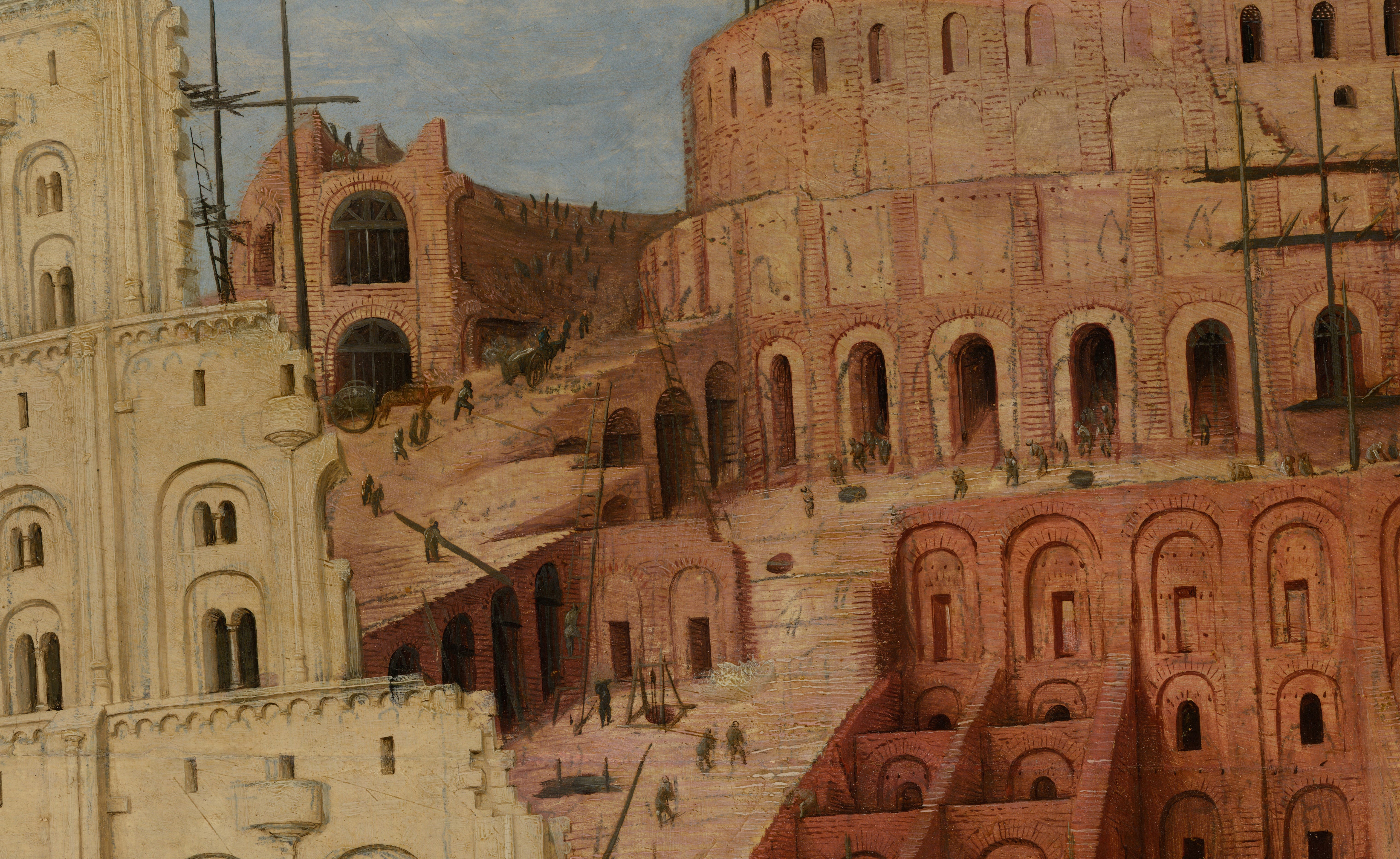
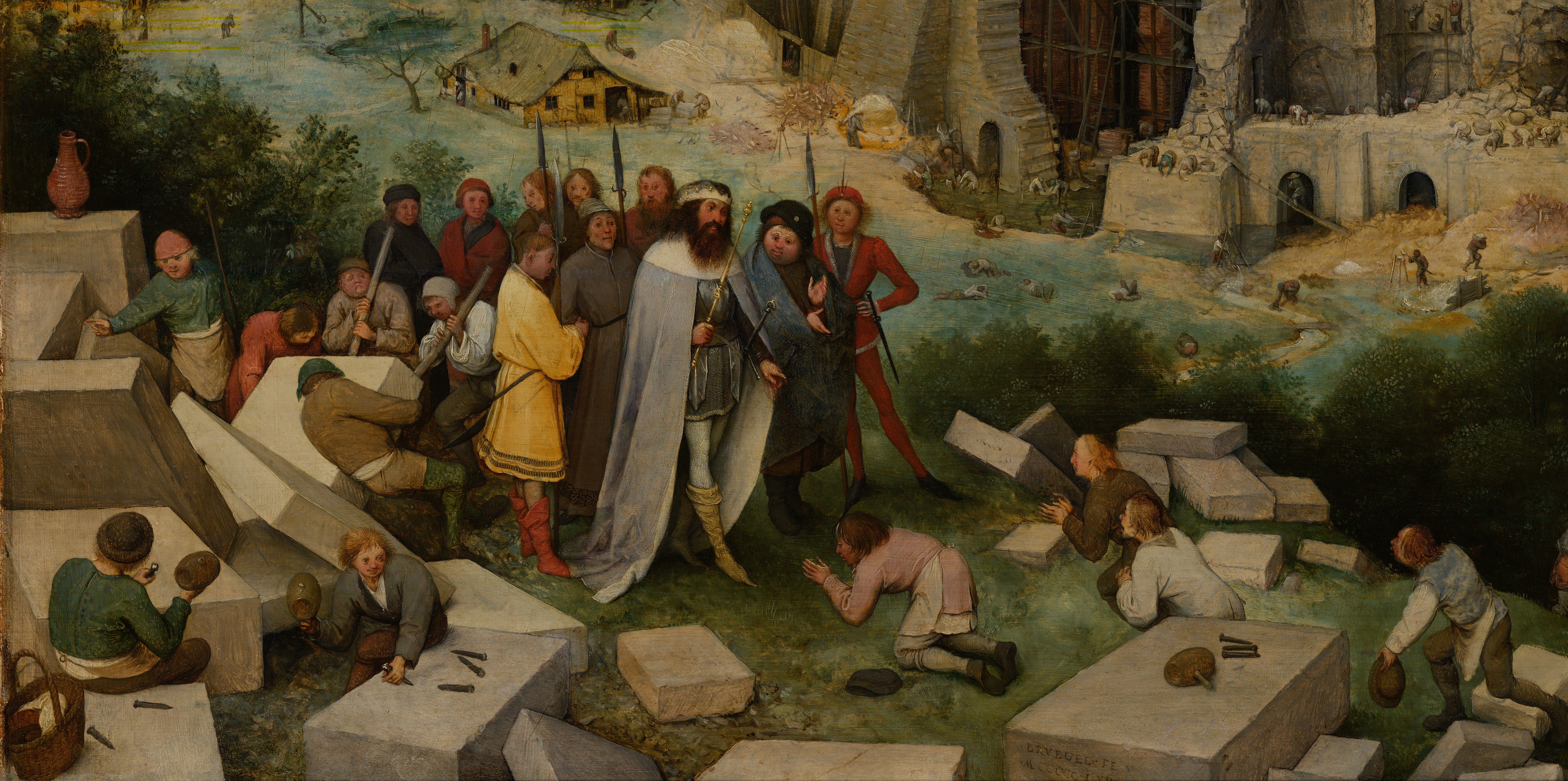
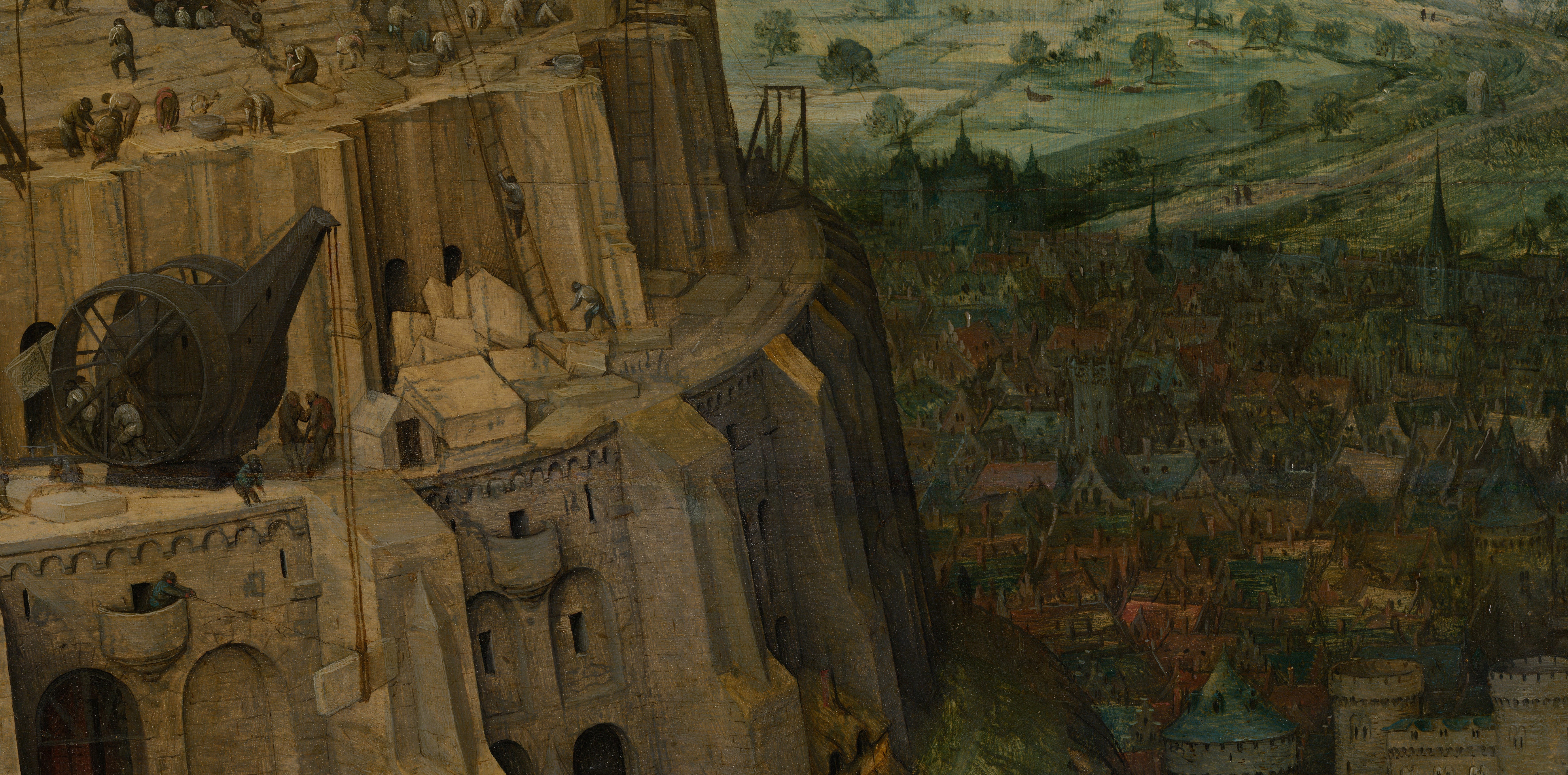
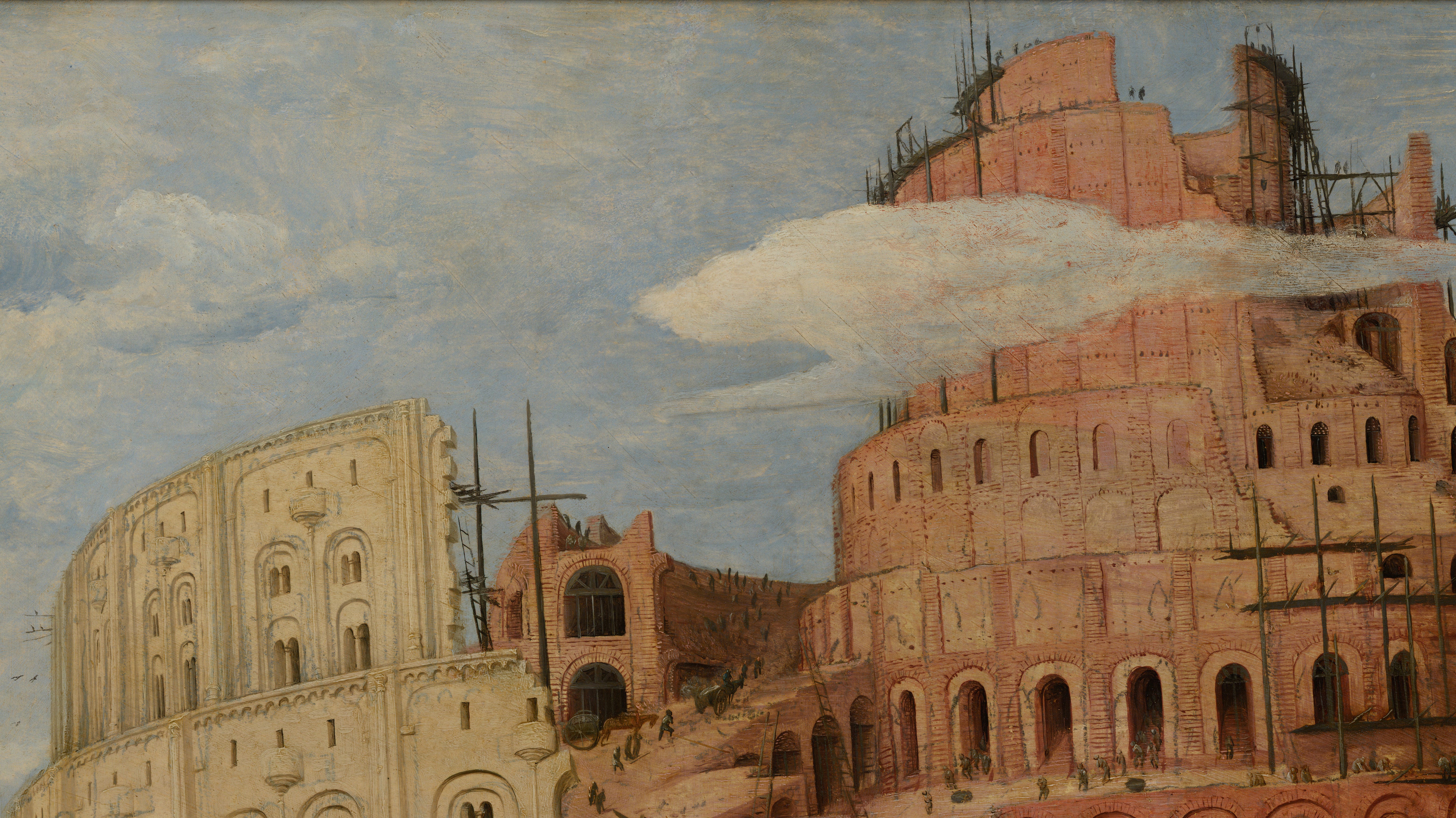
The city and the Tower
it’s belittled by:
Open in extreme wide
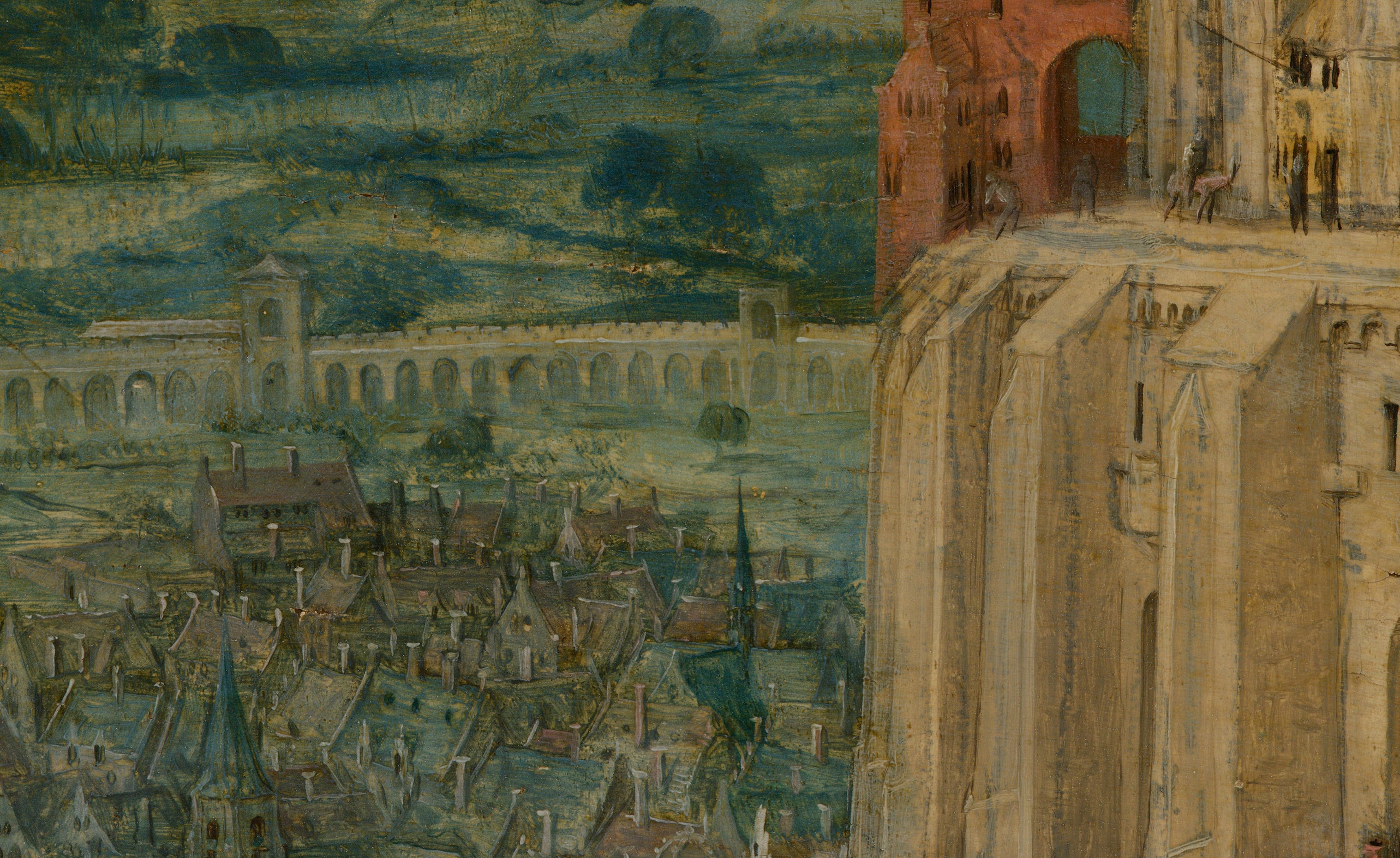
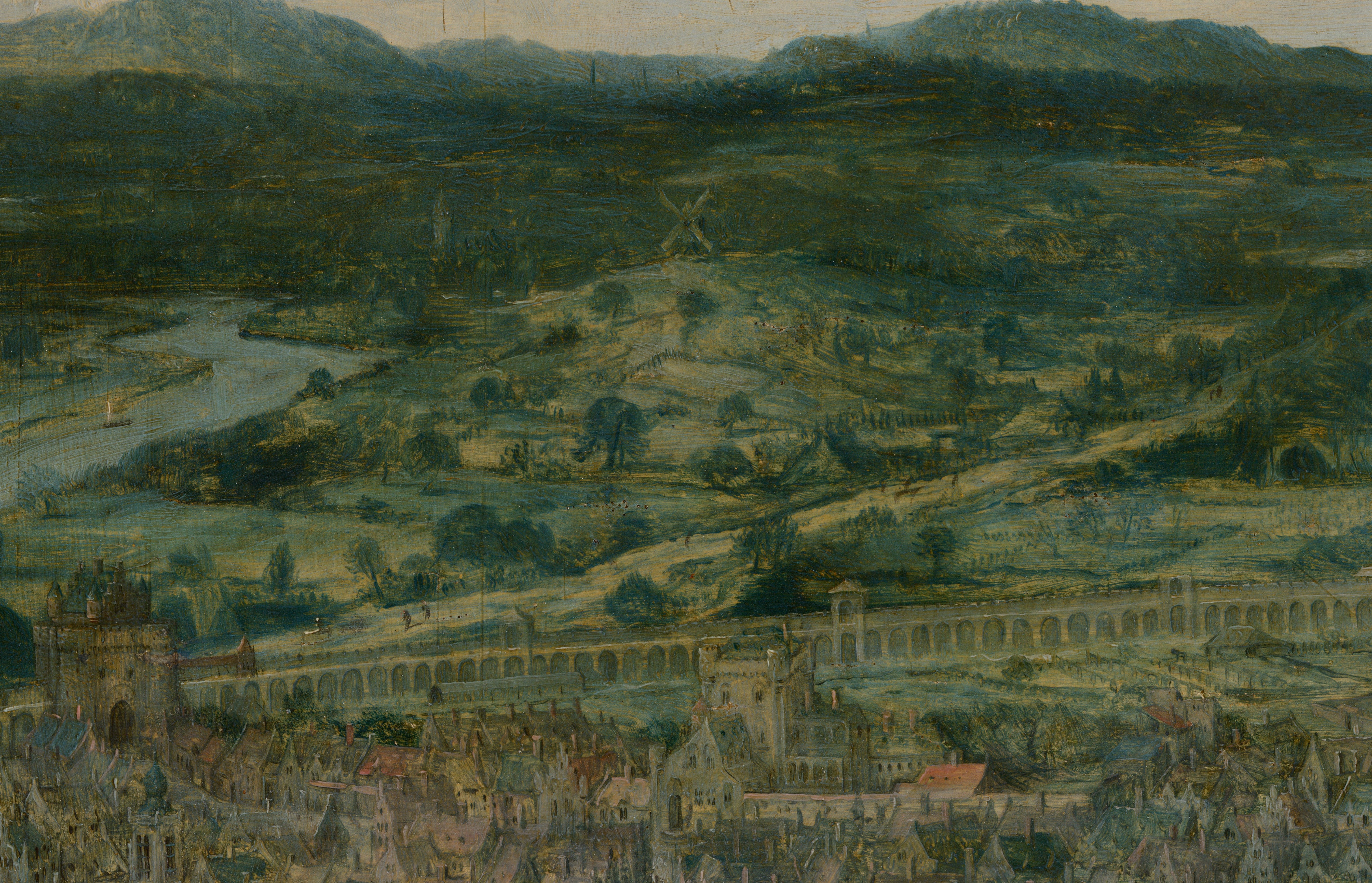
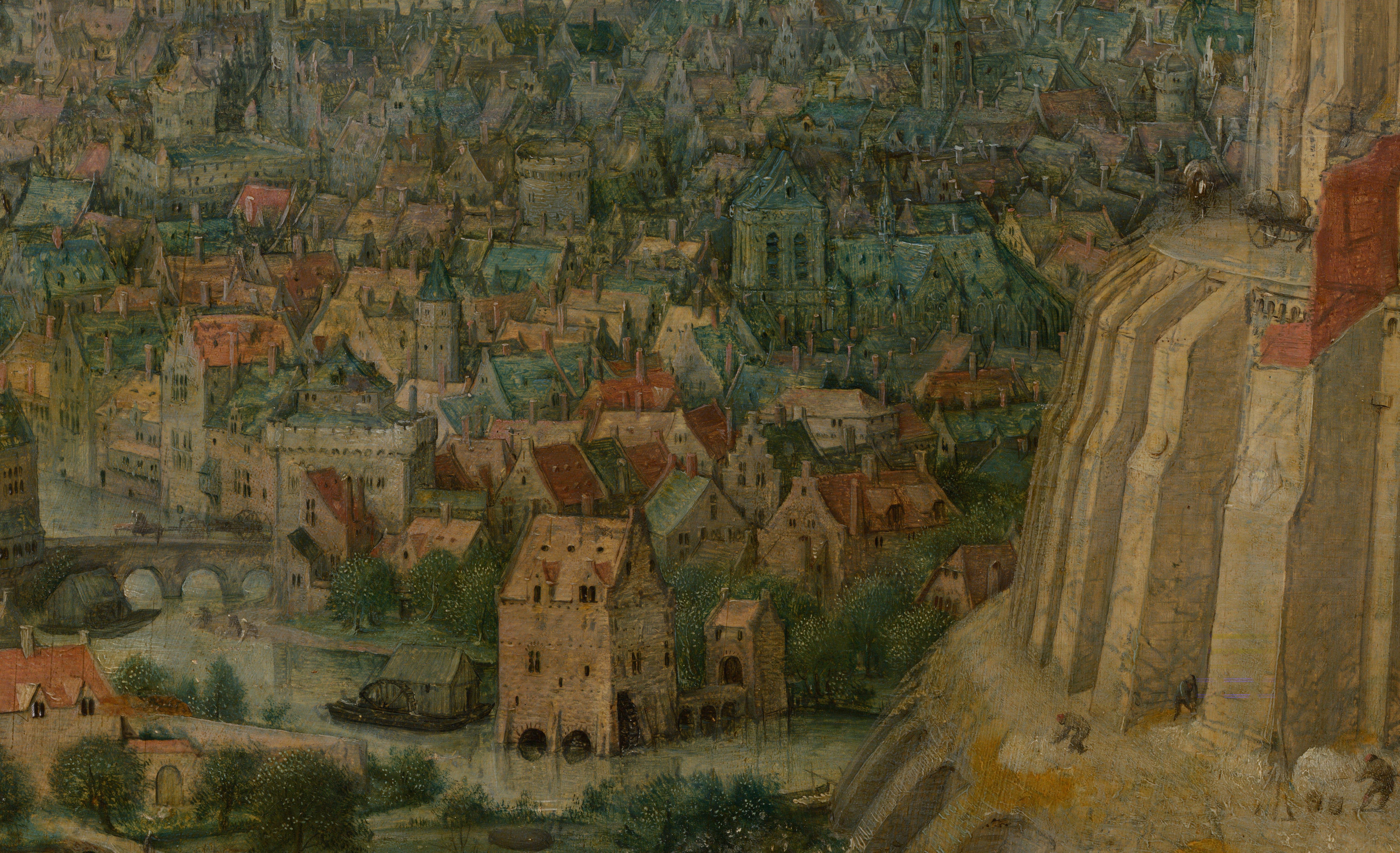
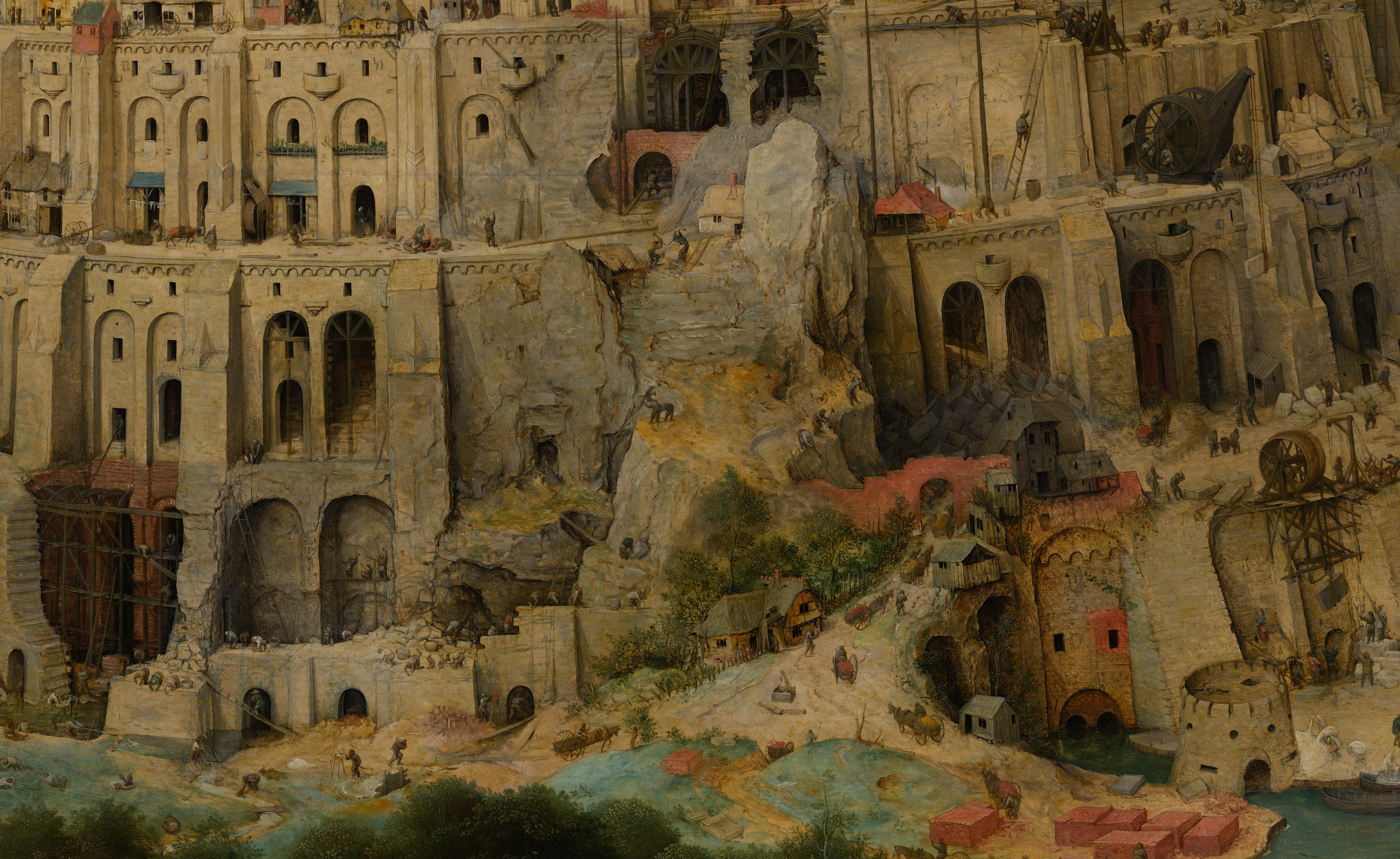
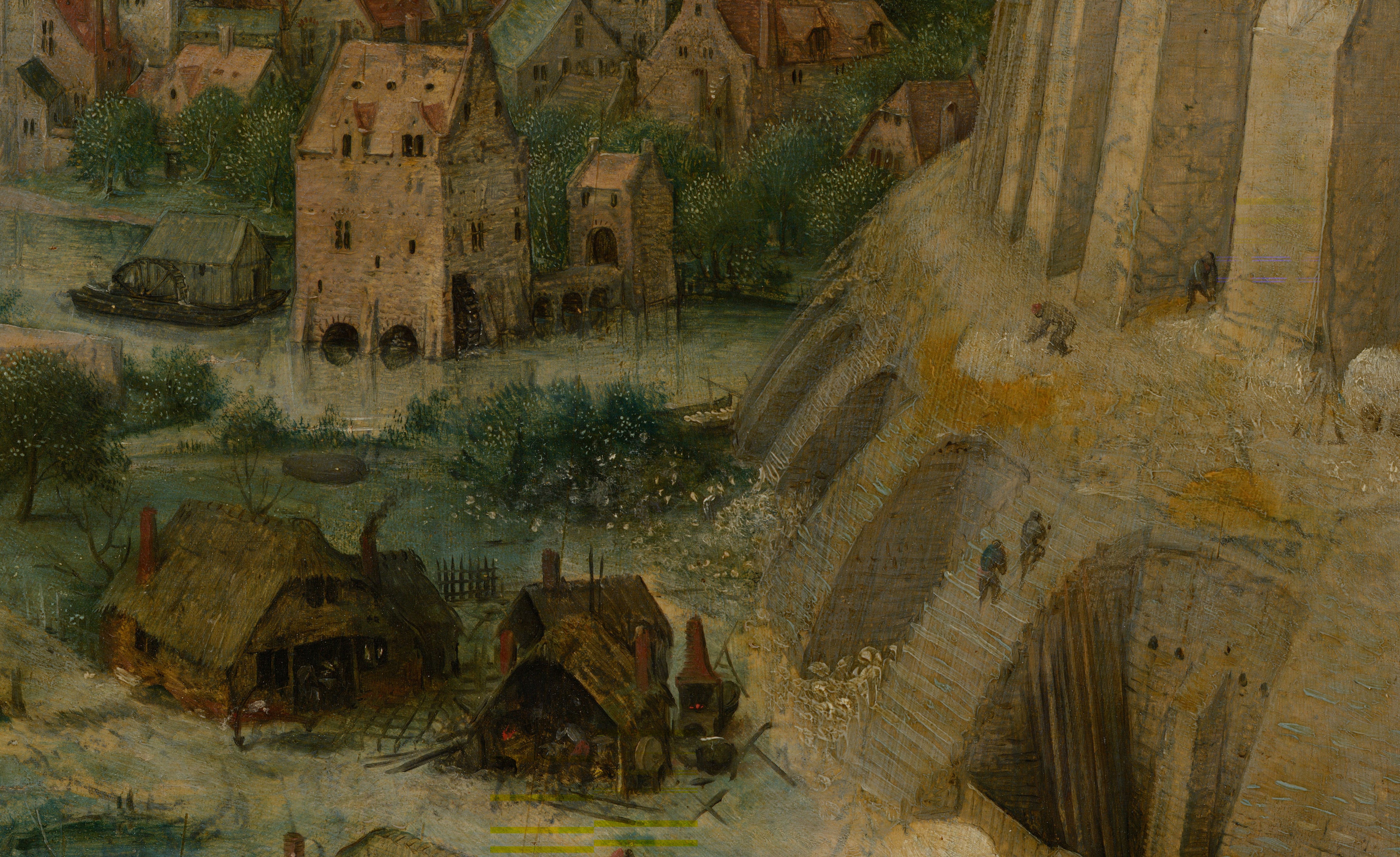
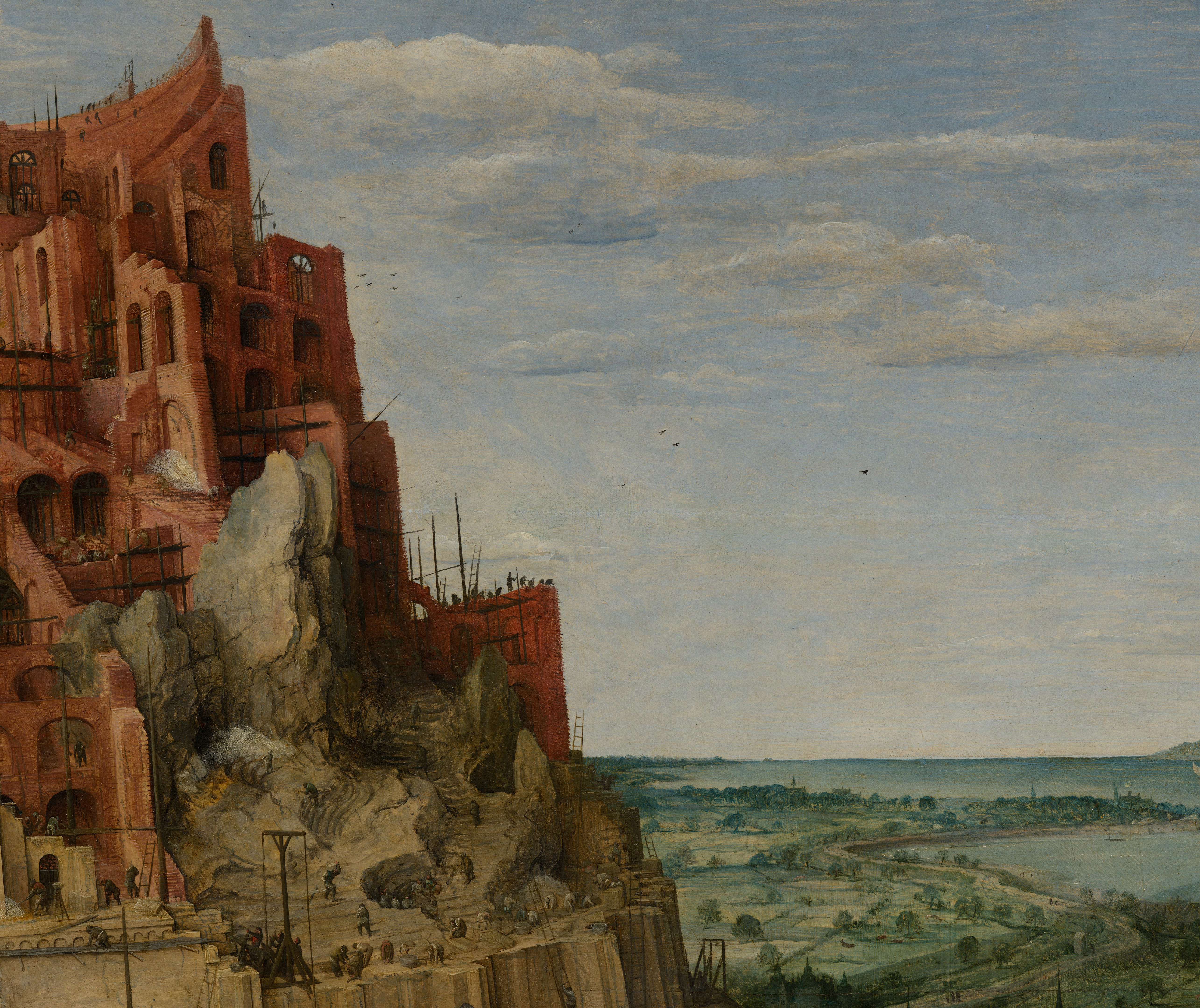
as in Bruegel.

The Tower’s grandeur,
buttressed by port, city, sky,
in its unfinished design figures
ambition’s folly and imposture.

Walk its several sides,
it cannot be encircled.
Remark how at every angle
it seems absurdly self-similar

until the sense becomes
a sinking one
that there are infinitely
many sides.

What need for it, though?
Don’t we have them already?
If it were up to me there wouldn’t be any.
If it were up to me it’d’ve been done long ago.

There was a time, it’s said,
when they began it, brought together
to set it down somewhere in the city
where a Tower did not yet exist.

No one can verify but all are free
to add, brick by brick,
their clarifications, and as it rises
be raised by its immense awareness.

But the Tower…
it houses at its center
a huge mass. It bends nature
and our wills around it.

Scabbing masonry, roads unfinished,
overgrown, flights of stairwells,
vaults and arches and crypts
to peer into its darkness.

Unmade, yet among arcades, a space
where a temple’s falseworks lay,
how it might have looked one day
if there were a sacred, needful place…

One age culminates in astonishment,
then turns to stony reverence. The next
inherits it, unimpressed, often incredulous.
They too are on their way to astonishment.

They will take up the work
and fashion it in their own image,
an image of the same Tower,
layer upon layer, recursive.

Golden in ratio. Always unfinished
yet symmetrical. Ancient and new.
Answering a dreamy prayer.
Cleaving heaven in two.

The Tower’s myth
the boy made real
the granted wish.
Wisdom is in remembering this.

So colossal so hyperbolical
those who work one side do not know
what on the other side goes on.
The right hand does not know its left.

Yet we’re certain we know our neighbors
are not like ourselves.
Men know their neighbors
better than themselves.

It will not be finished
in our lifetime.
It may not be finished
in any timeline.

Still it rises. Still it’s raised.
Still spacetime ekes out infinity
never knowing itself completely
for we’ve arrived cosmically

and what there is to know
cannot be known by accident.
The right hand
will never know its left.
II.
Tonight is jubilee.
Tonight a coterie
of demons will be
banished in ceremony.

No one who gathers
in the square speaks.
No one who goes into the woods
will enter unhooded.

The rite is called, translated,
Past becomes the Present again.
An effigy is burned, then a dance.
Something is recalled, and all is forgotten.

Things go on like this all night.
They once went on for several nights.
Our failed crops must be dug up.
The dead roots of another year.

What has been troubling
the mind.
An absence of love,
a cruel hand.

We gather to perform
on the woods’ edge
on the eve of spring.
We do not remember what it means

and this is partly to the point.
One imitates
then becomes
then is.

Tonight we begin by asking
a question we once knew
the answer to.
A new year will begin.

The cold will give way.
We must find out again
so we are not too late for spring,
as flowers are not late opening,

as deer are not late
to their lands in the north
where they know, when they arrive,
there will be green waiting.
III.
Intercut with prophecy.
An Ezekiel’s beard-spittle.
A Cassandra’s white, rolling eyes...

The earth forgets and
learns again in spring.
Men rise and fall replacing
themselves and their reigns.
Only the Tower remains,
The great burden of its city.
It increaseth without end,
to the edges of the city,
until the city is in the Tower
and the people do not know
the inside from the out.
And their children grow
in the shade of the Tower
and do not know the sun,
and when it shineth on them
they raise up the walls
to keep its light from their eyes.
And the Tower will grow too tall.
It will not last. Its stone will buckle
and snap all its falseworks like stalks.
Its great body will fall and sunder
the city to ruin, and the people
will live in caves and breathe dust
and wander three generations
before they behold the sun again.
So saith one of them
preaching in the square.

In that day shall five cities
in the land become one city
and speak one language,
swearing to the Lord of Hosts,
and be called the city wherein
the Tower was begun.
The righteous will seize it
and ring its bells and walk its halls
and set the prices in the market stalls,
until the people can remember how
the Tower was made by them and
must remain in the possession of all.
Then the foolish will seize it and they,
neither ringing bells nor walking halls,
will unbuild it, stone by stone.
They will start at the top, taking
the topmost stone and casting it
on the ground, and swear
not to build it up, but they
will increase it all around.
In those days one city
in the land will become ten
and speak ten languages.
So saith one of them
preaching in the square.

And the vision of all
of the Tower
will become unto you
as the words of a book
that is sealed.
I say unto you then,
when it comes to pass:
Fashion the instruments
of thy labor fast.
The season is spring.
A time for turning over soil.
Get thee to thy work.
Get thee to thy toil.
Do so happily, and sing
in the city and in the fields.
It must be you who breaks
the book’s mysterious seal.
The season is spring.
Fashion thy instruments.
Not arms of strife
that maim and pillage
but tools of civility.
I say unto you Reason
is the best of these.
Its mettle more valuable
than any won in war.
It leaves no wasteland
but increaseth its lands
more and more.
It subdues men without
stealing life from them.
It increaseth the life
of men more and more.
So saith one of them
preaching in the square.
IV.
Where will adventure be found
when the Tower’s imposing walls
enclosing Earth tenfold around
delimit all knowing within its halls?

Though everything there ever is
to know exists inside the Tower—
everything in its appointed place
under countless unnamed arcades—

Tomorrow strike out and seek
a space within those walls to wield.
Even a heart satisfied allows itself
to seek, to strive, and not to yield.

A day will come when a single
freshly observed idea will erect
its own Tower inside the one
grown gluttonous and grotesque.

And we will seek it out within,
venturing deep in its labyrinth,
into cloisters where none have been,
out of what dreams we cannot yet reckon.
V.
The wasteland grows.
Yellowing, whorling fringes of trees.
Curious attention a dog’s ears make
lifted to the wind as it clips the leaves.

We lay down our tools in confusion,
or wield them, in fear, to the breaking.
Subject to insensible warnings,
dire trumpets sounded by the future.

I’ve lost the meaning the Tower had
when I had first envisioned it.
What it meant then
now I can’t remember.

Woe to him who hides wastelands within.
Heaven is higher than we thought
but we will not content ourselves
with the blue nothing of the sky.

The next level is done but there remains
to be finished still another side,
and still a greater threat to decide.
The terrible dread weight of history.

Memory leaves devastation in its wake
when its ship descends the offing line,
sinking beyond sight, into oblivion,
all hope marooned, unmastered by time.

The child, inconsolable, rocked asleep
by its mother who whispers, Hush dear, hush!
Much was like this before you came.
Much the same will it be after you leave.

Disturb only the smallest part of it
and what was solid becomes like water.
The Tower ripples, shakes itself free
the way an autumn wind clips the leaves.
VI.
The brimful halo of the city,
its dome of bright against the dark.
All have found out what they are.
Some meant for rest, others pity.

The top of the Tower has fallen in.
Its broken fingers grasp at sky.
All of us who saw could not say why
though we saw it as it happened.

Earlier they cried out in the street,
a chorus of voices like waves
crashing down upon the deaf graves
of ancestors, raining down as sleet.

The Tower, they said, was corrupted.
Some added “It’s always been so.”
Devastation drives out all we know.
Naught will continue uninterrupted.

No night ever followed day
nor morning wore to evening
without some heart breaking
or will shattered on its way.

All have staked their claim.
All feel themselves in possession
of an answer to a deep question
and broker their chance to exclaim.

All proclaim to have been taught
yet each and every day we perform
uncountable acts that have not borne
a single scrutinizing counterthought.

What errors have been made believing
the right way is the way we know?
The Tower fell, and fell, too, long ago,
deep in the past, beyond all retrieving.

Conscience roams, mouthing corpse words,
sounding them out as a toddler does
to overhear a sense of what it was
that ages past many others had heard.

Our words come apart at the meaning.
Ours is rubble we no longer recognize.
The effort it took to raise it to the sky.
This ruinous debris of all our yearning.
VII.
Who sitteth down to feast?
To whom will the largest
portions be given?
And who among us
sitting down to eat
has understood the least?

The intrigue of the state
is fertilizer that sustains
next year’s wheat.
What group, when it
comes time, will harvest
what has been sown?

Let the whole land lie fallow.
Though we clamor to be fed
there must come a time
for replenishment and renewal.
A time for turning over soil
and quitting ceaseless toil.

A time when all things pass
out of memory and return
to us again, having shed
all that’s unnecessary.
Vital and restored from sleep.
There must come a time like this.

Every purpose under heaven
has its time, and everything
made beautiful in its own time.
The world is set in our hearts.
No man can find out the work
he makes from beginning to end.
VIII.
When I asked for Wisdom
I was given eyes to behold
all the work of God, and Lo!
A man cannot find it out,
all the work done under the sun.

He cannot find Reason
that will not dissolve
moment to moment
into opposing resolve.

Cannot find justice
generation to generation
that will not corrupt
and wrought devastation.

Though he toil all his life
to make sense of it, yet he will
be taken by contradiction,
will find himself mistaken.

If he build up his house
by years of labor, and it fall,
still he will not comprehend
how time and chance happen to all.

How can one who is ignorant
hope to understand? Everything
bears more thought. For all this
I considered and declared to my heart:

All things come alike to all.
There is one event
to the righteous
and the wicked.

To him that sacrifices
and to him that does not.
To both the same thing
meaning what it is not.

Then even the hearts
of the sons of men
are full of evil in them.

Madness is in
their hearts
while they live

and then they go
to their end as of
no great matter.

The oldest story is
how the dead die and
know nothing after.

Yet what persists
though love and hate perish—
God, the Form, the Ideal—
make their appeal

and we who come after ask
What is it?
and gather up our things
and make our visit.

So go thy way. Eat thy bread.
Drink thy wine merrily.
God accepteth thy work.

Live joyfully with the wife
whom thou lovest all the days
of thy vain, blinded life.

That is thy portion in life
and in the labor which
thou takest up under the sun.

Whatsoever thy hand findeth
to do, do it resolutely, with all
thy might, for there is no work

nor knowledge, nor device,
nor wisdom in the grave
whither thou goest.

And under the sun
time and chance happens
with or without our knowing.

The race is not to the swift,
nor the battle to the strong,
nor the bread to the wise

nor wealth or favor
to men of understanding
but time and chance to all.
IX.
Lord, give thy servant
an understanding heart
and I promise, whatever the soul is,
to build it a house and a hearth,
and tend to it as long as I live.

Later. Not continuous.

Thou didst well it was in thy heart,
when things were going well,
when there was plenty to eat
and safety everywhere to dwell.
Every man under his vine
and under his fig tree.

Cut to: the Dream.
Everything is golden.
A wife who loves him.
Kids eating ice cream.

He says whoever confesses
his lonely heart will know
the house of the soul
is a house of forgiveness.
X.
This wondrous workshop is abandoned.
The weird work of time broke it.
All the burnished masonry of cornerstone and cornice
Nature has reclaimed with clutching vine and tree.
Pavement uprooted. Stone faces strewn in rubble.
The roof gone, and green grows from the gables.
The artisans, who once forged miraculous figures at its benches,
quenched the braziers and hung up the tongs to gather rust.
On shelves their tools and masterpieces collecting shadow and dust.
The Master, whose solitary cottage with heavy heart I look upon,
the Muse to whom they all were apprenticed, where have they gone?
Only shades remain, the voided forms of voiceless specters
rehearsing absent rituals, repeating senseless gestures.
If it were rebuilt, would the shape regain its substance?
If the brush were cleared, and stone remade upon its foundation,
if the fire in the furnace were rekindled in abundance,
would the flame itself return of that sublime imagination?
I thought this might help other readers. Your mileage may vary, this was a quick pass over a long poem.
Epigraph: The mind can be overwhelmed by meaning.
I. Bruegel’s tower, like the tower of Babble, is a symbol of ambition and folly, here is described as a kind of Borgesian hall of mirrors, self-referential, unresolvable, built incrementally but every layer misunderstands the last. “The right hand / will never know the left.”
II. Reworking of part of Eliot’s 4 quartets where he describes natural cycles, which are benign, but forgetting is part of this natural cycle, to appreciate the spring like a deer, we have to constantly remember spring. Again, knowledge is ineffectual.
III. An inevitably perspectival take on the failure of the Tower. Prophet 1: the Tower keeps dominating more of human culture, and shutting us off from nature, like our cellphones! Things will fall apart. Prophet 2: People will fight over the tower, which now, seems like religion, one of many manifestations of human imagination. Even the iconoclasts will end up creating more towers, so the one Tower will become ever more diverse. Prophet 3: Get to work, be reasonable, sounds like the Enlightenment, but later in the poem will be seem as Biblical.
IV. The tower (here, human culture) seems to be complete, so leaves no space for regeneration. But there could be something there! Just keep looking in the nooks and crannies.
V. A cold wind threatens apocalypse. We give up our projects. What was the tower in the first place? We continue building, the past is devastated, hope is gone, but wasn’t it always like this? An almost Ashberian tonal switch.
VI. Now post-apocalypse, if the apocalypse is the collapse of the tower, here civilization. Is it useful to rebuild? Maybe it was always corrupt? People are too quick to answer here. But they’re jerks! There really was something in the past, and we are merely aping it, zombielike. We live among “This ruinous debris of all our yearning.” Yearning matters to Charbonneau.
VII. Political question of distribution and justice should be periodically set aside for renewal. Every purpose under heaven has its time. Amen. Also, we don’t know where we come from or where we are going, just do your work.
VIII. Wisdom? We don’t get the vastness of God and his creations. Reason and justice and toil just lead to contradictions. Time and chance happen to all, good and bad. The mad die without expecting or wanting anything else. But what about the ideal? This is a sermon—live joyfully with your pretty wife while you can! Do what you can do! Proverbs!
IX. We should tend our souls like a house. Build it and live in it. It’s really good sometimes. Forgiveness is key. This is a continuation of last section’s sermon, but it’s just notes, provisional now. Not as heartfelt, in fact a retreat the will culminate in X's strange reversal.
X. The workshop is abandoned, nature has taken over. Is that work as in “your limited thing you have to do,” or the call of the Tower or human imagination and rejection of limits. Who knows! Only repetition remains, but is it repetition of a ground truth or a repetition of all that yearning that led to the folly of tower. Maybe the next poem will answer these questions. We end with a fire in the furnace, the “sublime imagination.” Stevens for the win! Is this like the end of a dialectic Blake poem, where the cycle (or turn of the swirling floors of the Tower) begins again? Which would imply that the folly of the Tower is recurring, even just part of who we are.
I struggled with the first stanza, but man, this was a rewarding read. The juxtaposition of the tower narrative and the Qoheleth outlining the seeming futility and purposelessness of everything that happens "under the sun" really highlights how knowledge-accumulation failed to make humanity rational. But then the poem's final section: maybe, just maybe, we can build something better. Here's to hoping.