
Is Poetry an Art?

Not according to Plato.
And everything is a footnote to Plato.
In the Ion Socrates claims poets do not possess technē, craft. That is, they do not possess a formal body of knowledge that can be passed down, which is what craft is: teachable technique. Instead, Socrates says, what poets are up to is a matter of inspiration, in the old sense of the word meaning “breathed into” or “animated.” What poets do is enter into a state of possession, whether by gods, muses, daemons, geniuses, etc. Their composition is a kind of trance, and they less active participants than mouthpieces or receivers for divine beings. Such enthusiasm cannot be an art because it cannot be taught in the same way that carpentry or surgery can be taught. You can’t take a class on it. Though plenty of workshops and writer’s programs try to teach it. They call it ‘mindset coaching,’ a kind of corporatized version of divine inspiration.
This is only one definition of poetry, but no doubt anyone who’s ever written a poem has experienced, at least to some degree, inspiration like the kind Plato had in mind. We’ve all written something and later wondered how we did it. The novelty or felicity surprises us. We know we must have wrote it, but from where did the words come? Sometimes, after a frenzied, prolonged state of flow, we look down at what we’ve written and can’t believe it was us. Nor can we explain how we did it. “I don’t know,” we might say if asked, “it just sort of came to me.” That’s why the poet is perhaps the person least qualified to talk about his work. He cannot say what it means anymore than the reader, because he does not really know what he was up to when he wrote it. It makes more sense to say that he received the words than that he came up with them. It makes more sense to say they were bestowed on him from on high. This is one kind of poetic experience, and it’s what Plato was getting at. But such an act, involuntary, inconsistent, is nothing like an art. Even if one could learn how to become possessed, to enter into union with the muse at will (an improbable scenario, she’s so capricious) there’s no guarantee she would say anything so great to someone who did not already possess the poetic sensibility. Some people simply are vessels, others not.
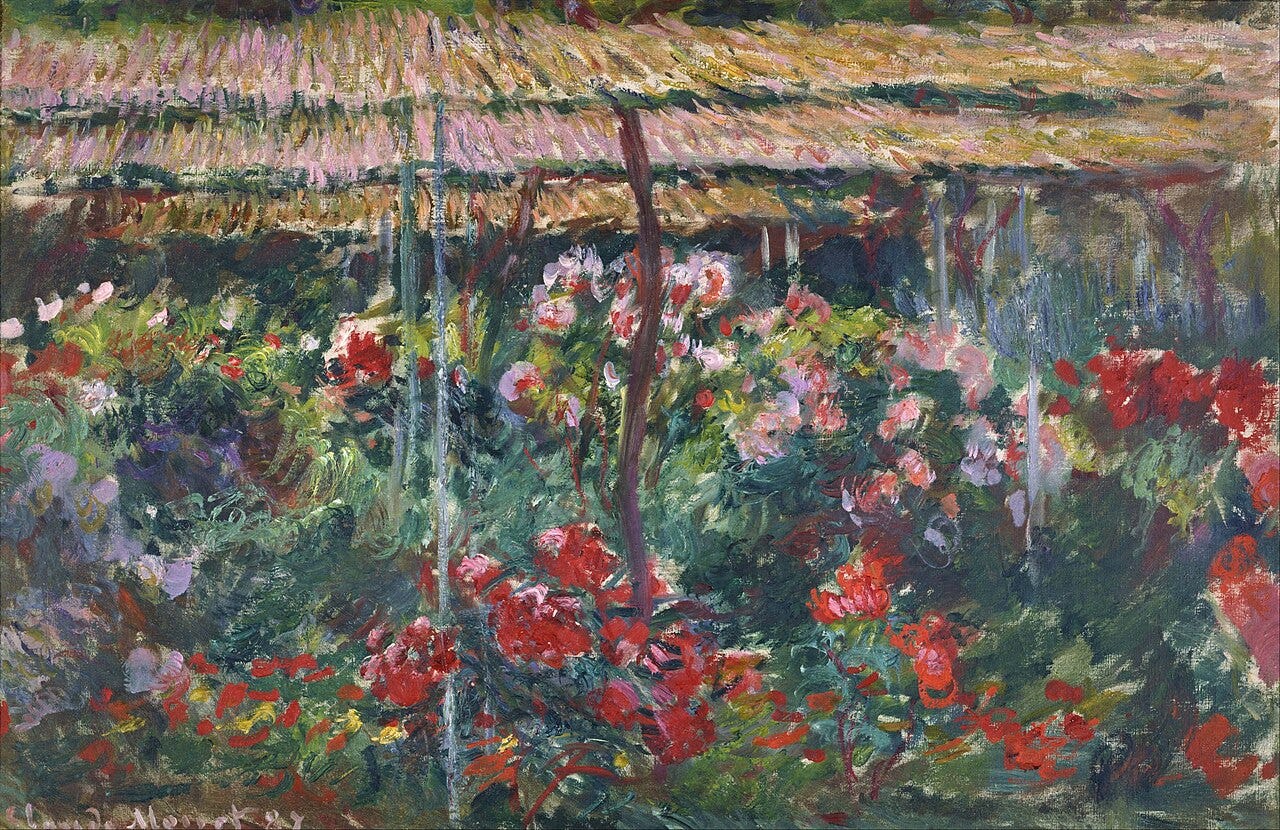
An opposing or complimentary definition of poetry can be found elsewhere in Plato. In the Republic, Socrates calls the thing poets do mimesis, or imitation. He says that poetry is a mimetic or representational art. What the poet does is try to imitate, re-present, figure forth, the natural world. Here we encounter the possibility for art, for presumably there are better or worse ways of going about representing things. From this definition will follow the whole body of knowledge that is technē: poetics, prosody, rhetoric, all the figures of speech and thought and sound that in language represent our world.
Imitation is the prevailing theory of art, although its meaning has shifted to include not only representation but also creation. As Puttenham said, the poet is both a maker and a counterfeiter, or imitator.1 Today when most poets talk about poetry, they use the word ‘expression.’ The aim of poetry is to express oneself. This is basically the creative principle, and I would not tend to disagree, if only it weren’t so often claimed as a way of refuting the idea that art is also imitative. It’s often asserted as if to say that art is this and not that, as if the two were mutually exclusive, which they’re not. Art is both imitative and expressive. In so far as poetry is imitative, it is craft. In so far as it is expressive, it partakes of the divine.
The theory of expression does not anyway refute the claim that art is imitative, for whatever we express is always expressed through a medium, and that medium is essentially mimetic. Even dance, which seems the most spontaneous and direct art, the line so thin between what we feel and how we express it. Yet it is still a form of representation, for the expression is never entirely identical with the conscious state that gave rise to it. Art is both imitative and expressive.
Poetry is the art of figuration. Poetry figures through language whatever is expressed. This is how it represents Nature. Although for Plato the undertaking was ultimately an unsuccessful one, and perhaps dangerous, because what is being imitated, Nature, is merely an imitation of the ideal reality of the Forms. Poetry, then, is an imitation of an imitation, a copy of a copy.
Aristotle followed Plato in thinking poetry was mimetic. However, unlike Plato, he did not distinguish between Nature and the realm of the Forms. For Aristotle, the poet does not imitate an imitation. Rather, what they represent is the general and the probable. “The kinds of things that might occur.” In his Poetics he contrasts this with history, which is interested in the actual and particular. Poetry, on the other hand, represents the universal in Nature.
Now this doesn’t seem all that different to me from claiming, as Plato did, a realm of eternal, abstract Forms, as what else are universals if not something like the Forms? The only difference is that Plato denied that we can represent such things, while Aristotle believed that that was exactly what the poet does represent.
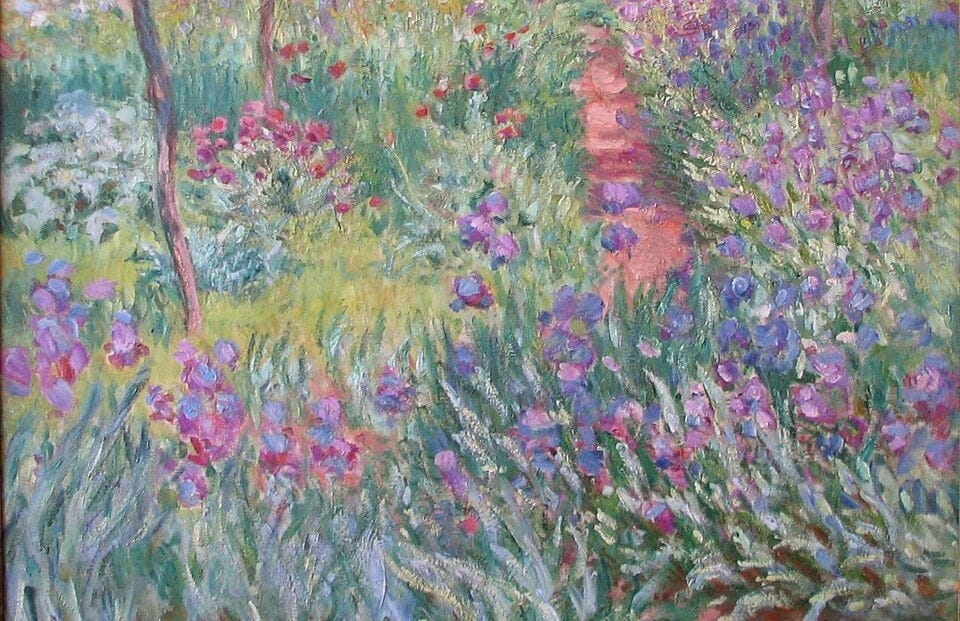
No doubt my conflating the two has to do with the way the ideas have come down to us. The Neoplatonists are partly to blame, for in conceiving what the artist does, they emphasized the imagination over imitation. In the first century, Dio Chrysostom claimed that, in order to represent the world, the artist must have a mental model within the imagination which sustains a continuous identity across changing observations. He used the example of the sculptor Phidias carving a statue of Zeus. In order for Phidias to have been able to fashion Zeus’s likeness over many years, he must’ve had in his mind a persistent idea or image of the god. Other Neoplatonists took up this example, eventually rejecting altogether art as imitation. Instead, they claimed, art is imaginative.2
C.S. Lewis described the change that took place in his Oxford History of 16th Century English Literature:
A century later [after Dio Chrysostom] Philostratus has gone farther. Again citing the works of Pheidias, and this time adding those of Praxiteles, he says that they were never produced by imitating nature. ‘Imagination made them, and she is a better artist than imitation; for where the one carves only what she has seen, the other carves what she has not seen’ (De Vita Apolloni, VI, xix). In the third century Plotinus completes the theory. ‘If anyone disparages the arts on the ground that they imitate Nature’, he writes, ‘we must remind him that natural objects are themselves only imitations, and that the arts do not simply imitate what they see but reascend to those principles from which Nature herself is derived. … Pheidias used no visible model for his Zeus (Enneads, v. viii).
Lewis says that such theories could be reconciled with Aristotle’s, but that they really pointed in a different direction. Art no longer as imitation but imagination. In this view, the artist does not merely imitate an imitation, as in Plato, nor does he represent the universal aspects of Nature, as in Aristotle: now he creates in his imagination a new world.
Art and Nature thus become rival copies of the same supersensuous original, and there is no reason why Art should not sometimes be the better of the two. Such a theory leaves the artist free to exceed the limits of Nature.
This is where our idea of art as creativity comes from. Although today the word, in its neutered, secularized form, has nothing like the force it once possessed. The idea that poets created from their imaginations something new was a scandalous and often heretical claim. The act of creation was something reserved for God. If we participated in it at all it was as vessels for divine possession, to return Plato’s first definition, not as creators but as receivers or transmitters. But after the Neoplatonists art was understood to be an act of the imagination. It became “creative,” which led the Renaissance scholar Scaliger (1540-1609) to conclude: “The poet maketh a new Nature and so maketh himself as it were a new God.”
The spirit of this idea was taken up by Renaissance poets. Sidney defended it against charges of heresy by arguing that it’s in keeping with the idea of Man being made in the image of God.
Neither let it be deemed too saucy a comparison to balance the highest point of man’s wit with the efficacy of nature; but rather give right honour to the heavenly Maker of that maker, who having made man to His own likeness, set him beyond and over all the works of that second nature: which in nothing he showeth so much as in poetry, when with the force of a divine breath he bringeth things forth surpassing her doings …
He earlier claims in his Defence that all art takes Nature as its “principal object.” Yet here, as in the Neoplatonists, imitation is not only representation, but creation. It’s not unlike Plato’s first definition of poetry as inspiration, for in the act of creating we draw on the divine breath of God. Yet at the same time the imitative is still present, for our ability to create rests on our being made in the Maker’s likeness. Our creative power is like that power that animates Nature. Art is both imitative and creative.
And Sidney believed, like the Neoplatonists, that what we create may “exceed the limits of Nature.”
Nature never set forth the earth in so rich Tapestry as diverse Poets have done, neither with so pleasant rivers, fruitful trees, sweet smelling flowers, nor whatsoever else may make the too much loved earth more lovely: her world is brazen, the Poets only deliver a golden.
The Renaissance poets would embody this new spirit of poetry, as that which we create in our imagination, imitating Nature but refashioning it, delivering it golden. Bacon would divide the three faculties of understanding accordingly, grouping history with memory, philosophy with reason, and poetry with the imagination.3 And thinkers like Hobbes and Descartes would attack poetry along these same lines, calling the imagination la folle du logis and criticizing poetry for being mere ornamentation or fancy that added to Nature things which were not real.4
Indeed, when Sidney or Aristotle or Plato spoke of poetry, they did not mean verse, but the mind’s ability to ‘make things up.’ Plato banished the poets for this very reason, and Sidney defended them for it. Aristotle contrasted poetry with history, emphasizing its ability to universalize, removed in a sense from reality, yet revealing its truth in doing so.
Poetry, in the sense in which I’ve been I’ve been discussing it thus far, has referred to this faculty of the imagination. What has not yet been touched on is any discussion of craft, of the thing that makes poetry an art. These things, more technical, more tedious, are perhaps less interesting, for they do not inspire, but are no less essential. They have to do with how one represents things. A body of knowledge built up over the history of language that includes poetics and rhetoric. They have nothing to do with divine inspiration, apart from having been created by it. Once created, they can be looked at dispassionately, and used dispassionately, as tools are used, with practice and precision.
The Art of English Poesy (1589)
The idea is not unlike Longinus’ phantasia, which was used to describe the power the poet had to behold the things he described as if they were right in front of him.
The Advancement of Learning (1605)
Both agreed that poetry should be tempered by opposing faculties reason and judgement.
I think so too. I was gonna look at some rhetorical devices in the next post. I started reading your piece the other day, but got distracted with something else. I have to come back and finish it.
I enjoyed this essay very much, Robert! Thank-you! I love Hopkins' exploration of the poetic process in "To R B"--"Sweet fire the sire of muse, my soul needs this; / I want the one rapture of an inspiration"--crafted within the limits of a sonnet. ✍🏻