
Saecula America
A Poem for America's 250th Anniversary

For the great Idea,
That, O my brethren, that is the mission of poets.
—Whitman
I - New Albion
They who went down to the sea in ships
To flee old Europe’s new apocalypse,
Slept in hulls till Christ ungraved their dust,
Until the resurrection of the just
In Jamestown, Plymouth, Massachusetts Bay,
In Maryland and Pennsylvania, away
From plagues worse than filled Pandora’s box;
They took their leave to New Albion’s rocks.
In the wild woods the exiled host were spread;
The heavens their covering, the earth their bed.
The poor and reprobate of God’s elect,
The persecuted and the promised sect.
Pilgrim, Baptist, Quaker, Jew and Catholic,
Creeds diverse exchanged, enthusiastic,
The hidden nerve that gave vigor to the frame,
And loaded souls with swaggering loads of pain.
New England, New Spain, New Netherland, New Sweden,
Toiling as Adam eastward for another Eden.
Their sermons full of doom and ponderous,
They for whom God had His special purpose
And would not spare it for His chosen few.
They would believe it with such certitude
That nowadays would beggar our belief;
Somehow gave thanks in the midst of their grief,
Gave thanks to soil that did not keep them fed,
Called the land a blessing as they buried their dead.
The worst begot from them more righteous contrition;
They could not be discouraged from their mission:
To manifest, by faith and deed, divine intention,
And know it by the art of reason called invention,
Scratching with a pen by candlelight
The nature of a ravished, inward sight.
The personal in Bradstreet’s contemplations.
The rustic metaphysics of Taylor’s meditations.
Discovering the simple, separate person,
The glorious and individual version.
The more they looked the more they grew amazed.
The more they gave the more they found to praise.
That awful genius of their clime whose birth
Heaven itself would claim for them upon the earth.
Great souls grow bolder in their country’s cause,
And bolder still, more unbelievable, in God’s.
II - Columbia
How like the old the New World starts again,
How like a Roman farmer-soldier-statesman,
New Englander or Pennsylvanian,
New Yorker, Georgian or Virginian,
They worked the fields one day, the next to war,
Then stood and argued on the Senate floor.
They beat their ploughshares into balls and muskets,
Then quarreled over equal laws and justice,
Discoursing in congress on the Rights of Man,
And taxes, and powers of the Federal Band.
How like a Roman they prized their liberty,
A common value forged by common enemy,
Whether Indian or Imperialist,
And by that genius of the colonist,
The simple, separate spirit, severally
United around a shared identity:
That Man is free and equal under God;
And being free, not subject to the rod
Unless by his consent and free election.

Enlightened, Man, his rational invention,
His looking glass for God, discovering by
His own free will His nature and divinity.
What can he reason from but what he knows?
And what he knows are God, himself, and those
Ideas inherited from his ancestors,
An English parliament and Roman Nestors.
Theirs was a refined, Augustan Age,
A mind set on Reason, formed by the page.
They wrote like Pope, and spoke like Cicero.
They knew de Montesquieu, Locke, and Plato.
Their wits were pointed, tastes sophisticated.
They read the papers and debated.
Their elites fancied themselves the equals
of the Europeans, and were—those peoples
Having taught them how to talk and think,
And from the same Pierian spring they’d drink.
A little learning was a dangerous thing
But they drank deep; the nation but a fledgling
Tempting in its youth the heights of art,
To argue on behalf of noble Man his heart.
Based on that rock of rights its empire stands,
Borne by the flags it brandished on its lands.
A New Republic founded in the west
To lend a great example to the rest—
To conquer if it must, its cause being just,
Proclaiming all the while, In God is our trust!
III - Americana
And now behold the great Idea progress,
A nation announcing itself, advancing through
The wilderness, chanting its carol of victory;
The work so recently begun, where Liberty
Enlightens Man, her voice awakening
Imprisoned seas and bounded lakes and lands.
The dark wood’s vesper-hymn to Liberty.
Down from Maine’s bleak breakers, and down
From the capes of Virginia whose blue banks
Slope their walls against the towering tide.
Up the noble James and Rappahannock,
Up the dull Susquehanna and Potomac;
Up broad Delaware and swift Kennebec,
Up majestic Hudson and Connecticut.
Beyond Vermont’s green hills, beyond the Berkshires,
The Adirondacks, and the Catskills, canals
Careering, climbing up the sunbright hills,
Through midland channels and redundant lakes
That vein the green and strow their nurturing rills.
Beyond the Shenandoah and the Blue Ridge
Mountains, beyond dark Pittsburg, its sparkling smoke
Of industry, beyond the valley of Ohio,
Till they marry the Hudson with Missouri’s wave.
Sweet river of the West, a purer wave.
Tranquil and smooth and clear its current roves
Through flower-meadow and long sylvan grove,
Winding in silence on its destined way.
And whither Providence commands them go,
To change a creed, or speculate in lands,
No matter which, they go with great purpose,
There to behold, where simple Nature reigned,
A thousand vices for one virtue gained.

The simple, separate spirit, free and full,
Confederate in freedom, democratic;
The individual, self-created soul,
Made in the image of its divine Creator
To learn from Nature’s fragments one great Truth:
That through the world, whatever man exists,
Involved in darkness, or obscured in mists,
The English, Welsh, the Scottish, Scots-Irish,
The Swiss, the Swede, the Dutch Pennsylvanian,
The French Huguenot, the Creek, the Cherokee,
The Choctaw, Chickasaw, Mohawk, Shawnee,
Oneida, Ojibwe, Onondaga, Cayuga,
The Congolese, the Nigerian, the Angolan,
The Ghanaian, the Tartar, or the Cantonese,
Take all, through all, through nation, tribe, or clan,
That child of Nature is the better man.
If Man would but his finer nature learn,
And not in life fantastic lose the sense
Of simpler things, could Nature’s features stern
Teach him to be thoughtful, tame elements,
And not live the slave to his own passions,
Well may he shine brightest on the borders,
Along the great Pacific, marking out
The path of empire. Thus, in their own land,
Ere long, the better genius of their race,
Having encompassed earth, and tamed its tribes,
Shall sit them down beneath the farthest west,
By the shore of that calm ocean, and look back
On realms made happy, swamp and pasturage,
Woodglade, canebrake, savanna, upland, prairie.
He who in the love of Nature holds communion
Shall embody and make manifest his destiny.
IV - The Union
We are the people with unshakable faith in Providence,
Our ideals brought down to us from the Shining Hill on parchment,
Commanding that all men are created equal,
Our Creator endowing us with rights that shall not be relinquished.
Life, the atom spinning, and Happiness, the joy of spinning;
Liberty that right to govern ourselves.
The soul is God’s, but ours the body,
Ours the simple, separate person,
Executive in ourselves, sufficient in the variety of ourselves,
The most beautiful to ourselves and in ourselves.
The body of the state is our responsibility,
For once enshrined, then enforced, for others’ sake,
On behalf of those who cannot give it to themselves.

So of course it must come to war.
And then is war terrible and glorious.
Then we wield ourselves against us.
Then are we powerful and tremendous.
Then our strengths, contested, glisten with dew on the grave-grass,
And our boots make the hair on the graves quiver.
And the low thunder of the south is dull and distant cannonade.
Then life emboldens us, death kisses our frames.
Then Time strews men like leaves upon the gale.
The curse and conflict of a tragic race.
The tempest bursting from the waste of Time
On the world’s fairest hope linked with Man’s foulest crime.
The grimy slur on the Republic’s faith implied.
Satan’s old age is strong and hale
But our eyes have seen the glory of the Lord marching on.
The Ancient of Days is forever young
And ever the scheme of Nature thrives.

And we who watch from the West, from our seat on the Pacific,
We hear the crack of riflefire, and pound of drum,
And hear, too, the stately hymning of our brethren:
Rest in thy Eternal Right, for thee, though levin-scarred and torn,
Through blood and crime and wrong, in flame and death, shall still be borne
The Red, the Azure, and the White.
We hear and see the light resolve in flame that evil long inwrought
With what was also the goodliest domain of freedom warded by the ancient sea.
We hear and see with the old Atlantic dream in our eyes
But a new Western morning on our faces. Arise, arise!
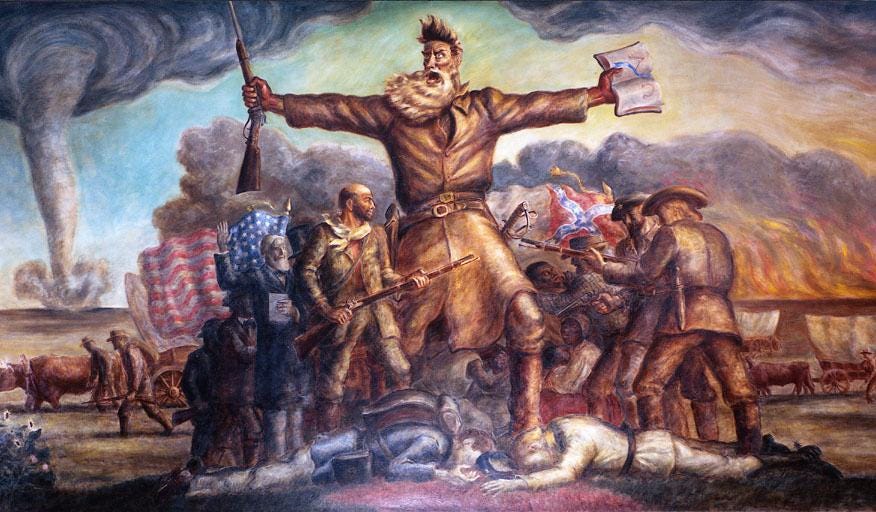
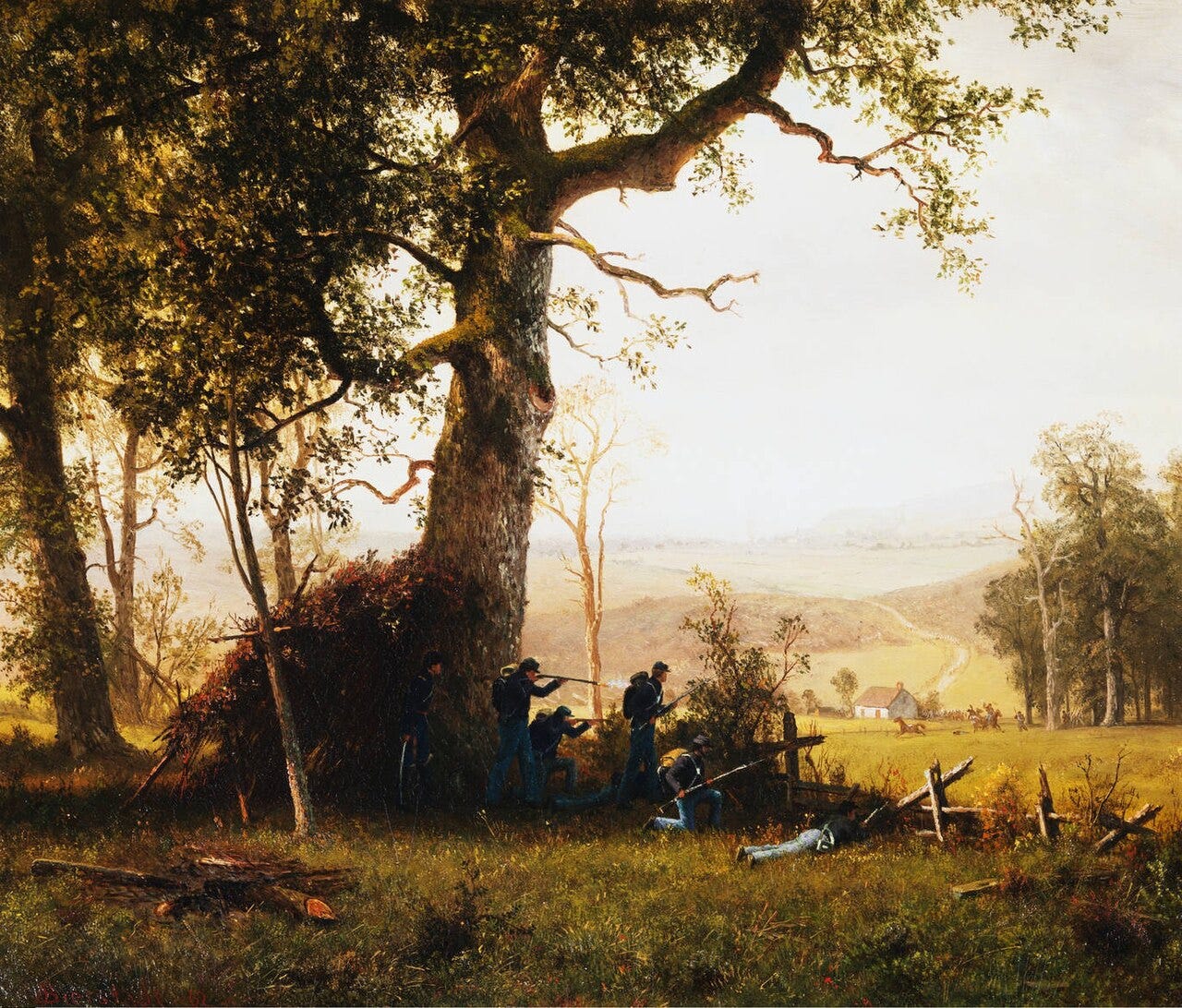
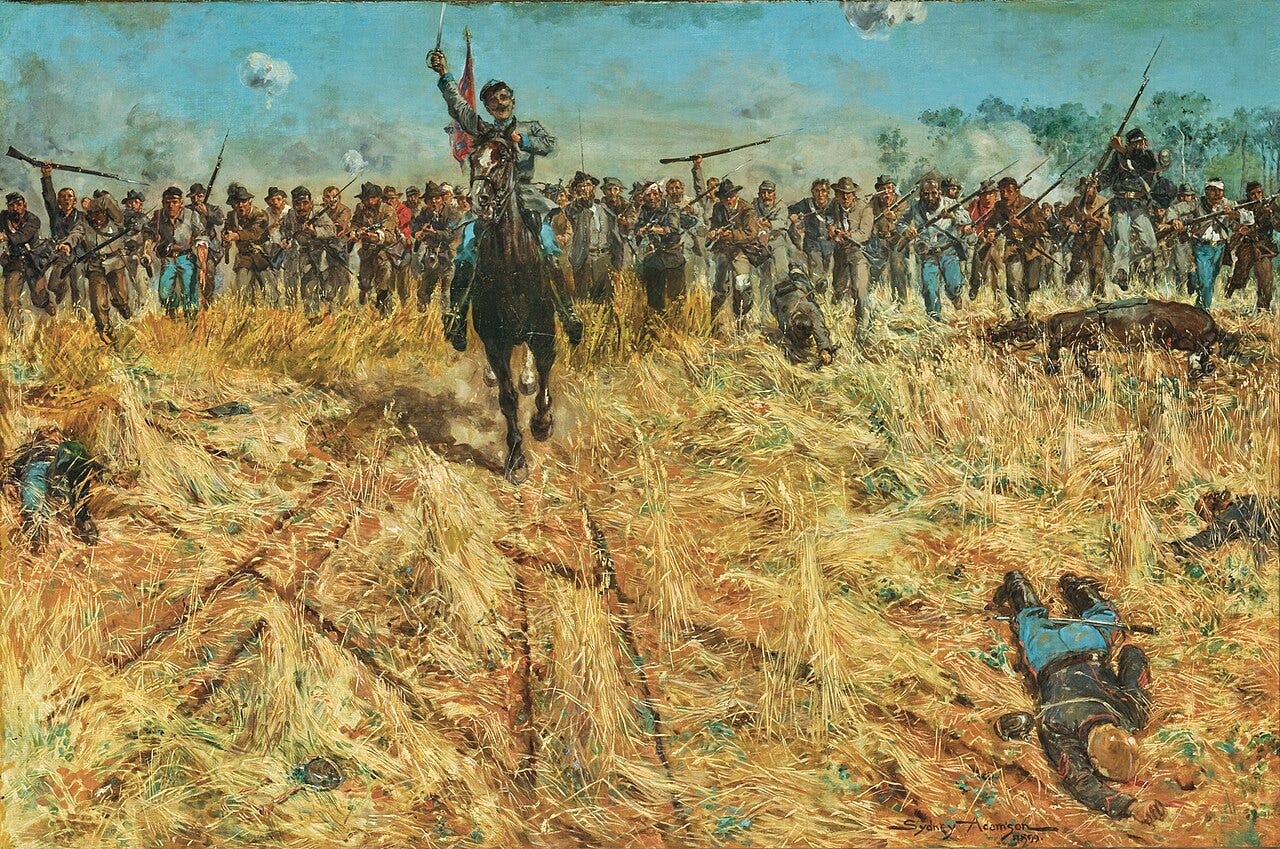
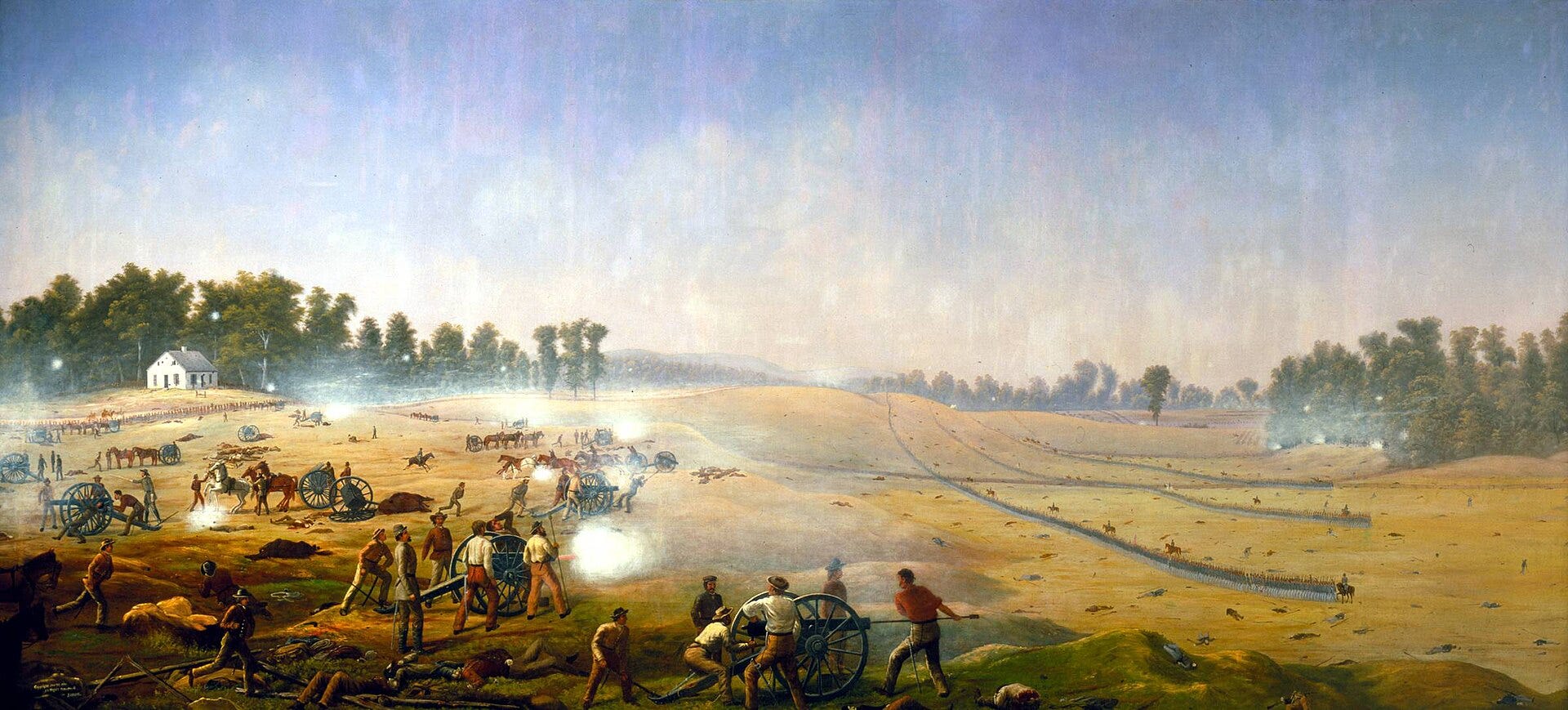
V - The United States of America
He’d had a replica installed, in marble
From Carrara, of that same statue
Whose blazing copper would often startle
Hosts of steamers and their immigrant crew.
The stone he’d purchased from a businessman
Who knew Italians, the sculptor was a Jew
From Poland. The total cost of it less than
A quarter’s earnings, but to him its value
To the foyer was inestimable,
For when he entertained, it drew the eye.
His taste to others seemed unquestionable.
A gilded New Colossus, five feet high.
He would sometimes pause before it,
Moving from the east wing to the west,
Admiring its beauty, or his shrewdness,
In private, or remarking to a guest.
Now he stopped, remembering the line,
A fair immortal form no worm shall gnaw.
Champagne in hand, and on his way to dine,
He stopped this time, and at her feet he saw
The fetters Liberty was treading on.
How had he never noticed it before,
The symbol of his country’s great agon,
The tyrant’s chains trampled on the floor?
A fearless Freedom brandishing her torch
To light the way forever more from tyranny
And guide the subjugated to her porch.
It’s right, he thought, and just, our liberty.
Here was her witness: this, her perfect son,
This delicate and proud New England soul
Who proved to history their shame was done,
That once more they were clean and spirit-whole.
As with the wrong world they proudly strove,
And warred, but nobly warred, to be released,
And by high deeds their wilder passions shrove,
Until all their slavish sufferings had ceased.
It’s right, he thought, and what a foolish thing,
How many fought and died so needlessly.
What had the States to do with slave or king?
Thank God we’re wiser than our ancestry.
And strong enough should justice call to battle,
Against Lakota brave, or fleet of Spain,
To threat with cannonfire and saber rattle,
To safeguard settler lands and free the main.
Not in conquest are the wars we wage.
The proud republic does not stoop so low.
We fight for justice ere we lift the gage,
And feed all with the freedom that we sow.
Of this he was assured, the figure’s stone
Like burnished flint striking sparks against
An impulse otherwise inert, unknown
Within a mind so staid with decadence.
Alas, theirs was an age of great decline
Of Nature’s busy old democracy,
Weathered by the breakers and the brine
That browned the laurel worn from sea to sea.
Life had no sleep so dense as that which lay
In streets left bare beneath the haughty skies,
Immaculate and deathful still decay
Of unremembered human miseries
Churned without purpose in the trough of change.
The monuments were raised, their moral gone,
Among the court and warehouse and exchange,
Implying only they could do no wrong.
The thought had come so nearly, and then not,
The vanity, the error of the whole,
The strong cross-purpose, oh, he knew not what
Cried dreadfully in his distracted soul.
These are really good! The parallels to the Roman Republic are striking and pretty much unknown to so many people today who never studied classics or history.
These are fantastic!